29.10.2026
Compact Cars for Polish City Centers - Parking, Maneuverability, Fuel
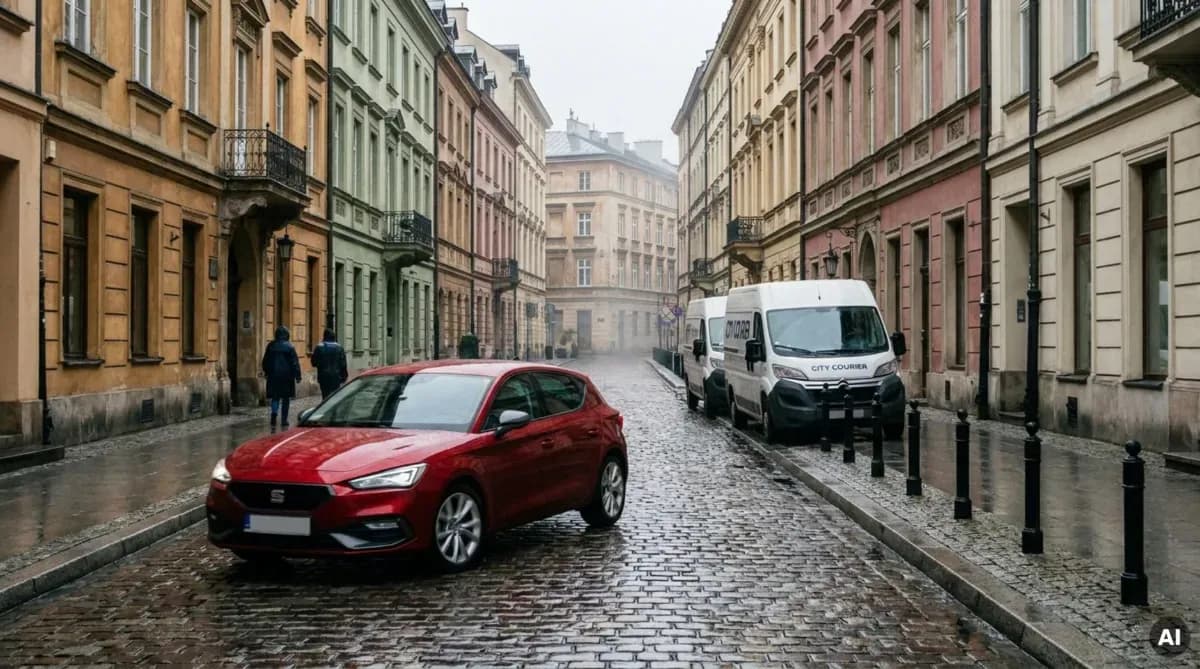
What makes a compact car ideal for navigating Polish city centers? The best models balance an overall length under four meters, a turning circle under 10 meters, and low fuel consumption in stop-and-go traffic to handle tight curbside spaces and meet Clean Transport Zone (Strefy Czystego Transportu, or SCT) requirements.
Choosing the right vehicle lets you travel with confidence through historic downtown streets while keeping daily operating costs predictable.
What Makes a Compact Car Suitable for Polish City Centers?
Polish city centers can test any driver's patience. Unlike planned modern suburbs with wide lanes, historic districts blend centuries-old cobblestones, communist-era thoroughfares, and dense modern residential developments. A car that feels composed on a ring road can quickly become awkward in the narrow lanes of Warsaw’s Mokotów, Kraków’s Kazimierz, or Wrocław’s Nadodrze.
City suitability isn't just about engine size or exterior styling. It comes down to how well a vehicle handles daily urban realities: delivery vans blocking curbside access, tram lines cutting across travel lanes, and high granite curbs that can punish sensitive suspensions.
Small Exterior Dimensions for Narrow Streets and Crowded Parking
Parking spaces in Polish downtown zones rarely follow standard sizing. While underground garages feature painted bays, street parking in central Paid Parking Zones (SPPN) means slipping between delivery couriers, mature trees, and protective posts. A car under four meters long can fit into tight spaces that midsize SUVs and estates simply have to pass by.
Width is just as critical, even if drivers often overlook it. On historic streets lined with parked vans, a narrower body with folding mirrors makes two-way passage far simpler. A vehicle under 1.75 meters wide (excluding mirrors) moves easily through tight corridors without forcing you to stop repeatedly or risk clipping a mirror on a passing city bus.
Short Turning Circles for Tight Intersections and U-Turns
A car’s turning circle defines the path required to make a complete 180-degree turn between curbs. This measurement determines how easily you can navigate missed turns, unexpected dead ends, or sudden diversions. Roadwork and utility repairs frequently alter city routes across Poland, leaving drivers to execute tight three-point turns in cramped spaces.
A turning circle under 10 meters makes these maneuvers stress-free. Instead of holding up traffic with multi-point corrections, a compact car with generous steering angle can rotate within a single lane or navigate tightly spaced pillars in an underground car park.
Raised Seating and Clear Visibility in Dense Traffic
Sightlines are frequently blocked in busy Polish centers. Delivery vans double-park outside local shops, pedestrians step out from tram islands, and electric scooters share lanes with vehicles. Low hatchbacks with steeply raked rear windows and wide pillars create blind spots right when you need maximum awareness.
A slightly elevated seating position, low beltline, and slim pillars let you spot pedestrians before they step onto a crossing. Upright glass and generously sized side mirrors also help you monitor the dense bicycle and scooter traffic that fills Polish cities during the warmer months.
Five-Door Access, Boot Space, and Everyday Practicality
While three-door micro-cars fit into remarkably small spaces, most households benefit from greater versatility. A reliable vehicle often needs to handle grocery runs, sports gear, and school drop-offs across town in addition to daily commuting.
Five doors make routine travel much smoother. Rear passengers can step in without moving the front seats, and installing child seats doesn't require wedging yourself into tight cabin angles. A well-designed boot offering 250 to 300 liters accommodates standard luggage, a folding pushchair, or heavy winter coats without dropping the rear bench.
Ground Clearance for Speed Bumps, Tram Tracks, and Uneven Roads
Urban roads throughout Poland demand a durable chassis. High manhole covers, uneven paving, steep ramp angles, and high curbs designed to prevent illegal parking are part of everyday driving. Low-riding sports hatchbacks risk scraping front aprons or underbody covers when entering older courtyards and parking garages.
Ground clearance between 145 and 160 millimeters provides a practical safety margin. Paired with tires that have generous sidewalls, this extra room protects wheels from sharp curb strikes and cushions your ride when crossing wet tram tracks at awkward angles.
[Find a small, fuel-efficient city car in our fleet]
Compact Car Dimensions and Features Worth Comparing
It pays to look past generic marketing categories. Dealerships often group micro-crossovers, B-segment superminis, and A-segment city runabouts under the "compact" label. Yet vehicles with nearly identical overall lengths can offer noticeably different cabin space, cargo room, and structural protection.
To find the right fit, focus on how well the platform uses its footprint. Short overhangs, intelligent battery placement, and urban-tuned suspensions transform modest exterior dimensions into comfortable travel that handles highway connectors with equal poise.
Boot Capacity and Rear-Seat Space for Daily Errands
Boot capacity in compact cars depends heavily on rear suspension packaging and where the fuel tank or battery sits. Many entry-level A-segment models offer 200 to 260 liters-fine for weekly groceries, but restrictive when heading to the airport with luggage. Better-packaged B-segment hatchbacks expand that volume beyond 350 liters by using compact torsion beams and optimized rear bodywork.
Rear passenger space varies just as much. Flat floors and sliding rear benches let you adjust between legroom and boot volume as your plans change. A 60/40 split-folding rear bench remains a practical must-have, allowing you to carry longer cargo while keeping a seat open for a rear passenger.
Visibility, Driving Position, and Cabin Comfort
A poorly configured driving environment quickly causes fatigue in slow-moving traffic. Your seat needs comprehensive height adjustment, and the steering column should adjust for both reach and rake. These adjustments prevent taller drivers from feeling cramped under low rooflines. Generous window areas offer far more daily utility than aggressive, coupe-like profiles that restrict outward vision.
Cabin acoustics also play a big role in driving comfort. Good sound deadening in the firewall filters out the clatter of commercial diesels and the hiss of wet asphalt. For in-car controls, physical switches for cabin temperature and audio volume let you adjust settings without taking your eyes off complex intersections.
Ride Quality Over Potholes, Cobblestones, and Tram Crossings
A short wheelbase can make a car feel jittery over broken surfaces. On historic cobblestones near Kraków’s Stare Miasto or in Poznań’s Jeżyce, an overly stiff suspension transfers harsh vibrations straight into the cabin. Polish city routes benefit from progressive damping that absorbs sharp impacts without allowing excessive body roll.
Wheel choice directly affects that balance. While larger 17-inch or 18-inch wheels look sharp, modest 15-inch or 16-inch setups with taller tire sidewalls offer superior absorption on uneven pavement. The extra tire profile absorbs shocks from sunken tram tracks, protects rims from curb rash, and lowers ongoing replacement costs.
Safety Equipment, Euro NCAP Ratings, and Driver-Assistance Systems
Urban driving involves frequent low-speed interactions with traffic, pedestrians, and cyclists. Crash integrity remains vital even below highway speeds. Euro NCAP subjects small hatchbacks to the same stringent safety assessments as large executive saloons, and modern compacts can achieve top safety scores through high-strength passenger cells and comprehensive restraint systems.
Active driver aids offer valuable peace of mind. Autonomous Emergency Braking (AEB) with pedestrian and cyclist detection steps in when someone steps into your path unexpectedly. In addition, blind-spot monitoring and rear cross-traffic alert protect against approaching bikes and make reversing out of angled parking bays far safer.
Parking and Maneuverability in Warsaw, Kraków, Wrocław, and Other Polish Cities
Downtown parking in Poland's major hubs requires patience and precision. Historic centers feature strict time controls, escalating tariffs, and camera-equipped enforcement vehicles scanning registration plates. In busy downtown areas, a significant portion of traffic often consists of drivers circling blocks searching for an open bay.
Under these conditions, agile handling directly improves your daily routine. Fitting into a tight parallel space on your first attempt-rather than blocking a lane while making multiple corrections-comes down to compact exterior dimensions, responsive steering, and effective parking aids.
Model | Length (m) | Width w/o Mirrors (m) | Turning Circle (m) | Boot Capacity (L) | Primary Urban Advantage |
Toyota Aygo X | 3.70 | 1.74 | 9.4 | 231 | Tight turning agility with raised ground clearance |
Toyota Yaris Hybrid | 3.94 | 1.75 | 9.8 | 286 | Sub-4.0 L/100 km city economy and smooth e-CVT operation |
Škoda Fabia | 4.11 | 1.78 | 10.4 | 380 | Class-leading boot space and practical passenger room |
Fiat 500 Hybrid | 3.57 | 1.63 | 9.3 | 185 | Exceptional parking agility with ultra-light City steering |
Hyundai i10 | 3.67 | 1.68 | 9.8 | 252 | Spacious five-door layout with low running costs |
How Vehicle Length and Width Affect Parallel Parking
Parallel parking involves more than matching your car's length to an empty spot; you also need entry clearance. While marked parallel bays typically span around six meters, curbside parking on older streets rarely includes painted boundaries. Drivers park bumper-to-bumper, leaving minimal margins. A car under four meters long can slip cleanly into a 4.5-meter gap that would leave a 4.6-meter saloon stranded in the travel lane.
Width determines how much room remains between your car and moving traffic. A wide car parked against the curb still projects toward passing delivery trucks and buses. A narrower body stays safely within the parking bay, lowering the chance of mirror damage and letting you open your door without stepping directly into bicycle traffic.
Turning Radius, Steering Response, and Low-Speed Control
Direct low-speed steering makes navigating tight underground parking garages under commercial centers and apartment blocks much easier. Models with tight turning circles-like the Fiat 500 at 9.3 meters or the Toyota Yaris at 9.8 meters-sweep down spiral ramps without repeated steering adjustments.
Steering calibration matters just as much. Many city cars feature selectable electric power steering. Dedicated urban settings, such as Fiat's City mode, lighten steering resistance so you can turn the wheel effortlessly with one hand during parking maneuvers. A progressive steering rack also reduces arm movement when navigating roundabouts.
Parking Sensors, Reversing Cameras, and 360-Degree Cameras
Parking sensors and cameras are invaluable tools for tight spaces. In dim lighting or poor weather, a high-resolution reversing camera with dynamic guidelines helps you approach concrete stops, low bollards (słupki), and bicycle stands that fall below your rear windowline.
Surround-view 360-degree cameras take visibility a step further. By providing an overhead perspective on the center screen, they show exactly how close your tires are to the curb. This keeps your alloy wheels clear of rough granite edges when sliding into tight spaces.
How Automatic Gearboxes Reduce Stress in Stop-And-Go Traffic
Creeping along Warsaw’s Aleje Jerozolimskie, Kraków’s Aleja Trzech Wieszczów, or Wrocław’s inner ring road during evening rush hour demands constant low-speed control. Operating a manual clutch in stop-and-go traffic leads to driver fatigue and accelerates wear on the clutch plate.
Modern automatics-including e-CVTs in full hybrids and responsive dual-clutch units-deliver a smooth journey through congested avenues. An electronic parking brake with Auto Hold adds further convenience, letting you relax your foot at long traffic signals without rolling backward on bridge inclines.
Parking Costs, Paid Zones, and Residential Permits
Municipalities across Poland use Paid Parking Zones (SPPN) to regulate curb space in busy districts. Major cities manage tens of thousands of metered spots, often using tiered pricing where hourly rates increase for longer stays. This pricing structure makes all-day street parking costly for daily commuters.
City residents can lower these expenses through a local residential permit (abonament mieszkańca). These permits provide substantial savings over standard hourly fees within a designated zone around your address. However, eligibility rules are strict: permits require formal vehicle registration, proof of residence, and local tax filings. Make sure your vehicle paperwork is in order before relying on on-street residential parking.
Best Small Petrol Cars for Polish Urban Driving
While electrification continues to grow, petrol-powered compacts remain widely popular throughout Poland. Their accessible upfront price, straightforward mechanics, and easy servicing at independent workshops make them a dependable choice for cost-conscious drivers. They deliver reliable transportation in all seasons without the need for dedicated charging access.
Modern petrol city cars rely on lightweight three-cylinder engines, variable valve timing, and direct fuel injection. These engines deliver responsive low-end torque, allowing you to move away from traffic signals briskly and keep pace with city traffic while keeping fuel consumption modest.
Toyota Aygo X: Compact Dimensions and Low City Fuel Use
The Toyota Aygo X brings crossover styling to the city segment. Measuring 3.70 meters long and sharing chassis components with the Yaris, it provides an elevated driving position that improves visibility over nearby cars. Its 9.4-meter turning circle makes parking in crowded streets simple and intuitive.
Under the bonnet sits a naturally aspirated 1.0-liter three-cylinder engine. While joining fast highway bypasses requires working through the rev range, city fuel efficiency remains strong, typically settling between 4.8 and 5.3 liters per 100 kilometers. Generous ground clearance and durable body cladding help protect the chassis from broken pavement and tall curbs.
Hyundai i10 and Kia Picanto: Affordable City-Car Practicality
The Hyundai i10 and Kia Picanto prove just how much interior space engineers can fit into a platform under 3.7 meters. Both cars position their wheels near the outer corners, creating enough cabin space for four adults alongside modern, user-friendly dashboard layouts.
Engine choices include an economical 1.0-liter unit and a punchier 1.2-liter four-cylinder. Both models combine affordable purchase prices with modest running expenses. Straightforward controls, long factory warranties, and seamless smartphone integration make them exceptionally practical choices for everyday commuting.
Fiat 500: Easy Parking and Distinctive Urban Styling
The petrol Fiat 500 remains an urban design icon and an exceptional tool for dense parking environments. At just 3.57 meters long, it slips into curbside spaces other drivers have to pass up. Its tight turning circle and light City steering mode make tight maneuvers effortless.
Its 1.0-liter mild-hybrid three-cylinder engine works alongside a six-speed manual gearbox, returning low fuel figures when driven with a smooth throttle foot. While its three-door layout and compact rear quarters limit rear-seat flexibility, its distinct character and parking ease make it an appealing urban runabout.
Volkswagen up! and Škoda Fabia: Efficient Options for Daily Commuting
The Volkswagen Group offers two distinct approaches to urban transport. On the pre-owned market, the Volkswagen up! remains highly regarded for its space-efficient design, solid highway composure, and efficient 1.0-liter MPI engine.
If you need greater versatility, the Škoda Fabia provides family-sized utility in a 4.11-meter body. It boasts a 380-liter boot that rivals vehicles from the class above. Powered by responsive 1.0 TSI turbocharged three-cylinder engines, the Fabia offers a compliant ride and well-insulated cabin that works well as a primary household vehicle.
Suzuki Swift and Peugeot 208: Light Handling With Extra Comfort
The Suzuki Swift stands out for its lightweight construction, weighing well below 1,000 kilograms. Its 1.2-liter Dualjet engine incorporates mild-hybrid technology to deliver average fuel consumption around 4.8 liters per 100 kilometers. The low kerb weight translates to agile handling around busy city roundabouts.
The Peugeot 208 prioritizes interior design and refinement. Its i-Cockpit layout combines a compact steering wheel with a raised digital instrument cluster, giving the car an engaging feel in traffic. Supple damping absorbs broken pavement effectively, making it a comfortable companion for longer crosstown trips.
[Rent a compact car for driving around Warsaw]
Hybrid Cars That Reduce Fuel Use in Polish Traffic
Full hybrids (HEVs) are exceptionally well-suited to Polish city conditions. Unlike plug-in hybrids or battery-electric cars, they don't require home wallboxes or visits to public charging hubs. They recover kinetic energy during deceleration, storing power in a compact traction battery rather than losing it as brake heat.
In crawling city traffic, a full hybrid operates on battery power for extended stretches. The electric motor handles initial pull-away from a stop-the exact moment standard petrol engines burn the most fuel. This system cuts tailpipe emissions and delivers outstanding fuel savings in heavy congestion.
Toyota Yaris Hybrid: Efficient Driving in Congested City Streets
The Toyota Yaris Hybrid remains a benchmark among compact urban cars. Measuring 3.94 meters long and 1.745 meters wide, it slips through downtown streets with ease. Its 1.5-liter three-cylinder engine pairs with an electric motor and an e-CVT planetary gearbox, ensuring smooth acceleration without gear shift interruptions.
In heavy traffic, the Yaris Hybrid consistently returns fuel economy between 3.4 and 4.2 liters per 100 kilometers-outperforming conventional petrol options. A sub-10-meter turning circle, robust safety suite, and proven reliability make it a popular pick for private drivers and modern fleet operators alike.
Renault Clio E-Tech: Hybrid Comfort With Practical Hatchback Space
Renault’s Clio E-Tech uses an innovative clutchless multi-mode gearbox derived from motorsport engineering. Its 1.6-liter petrol engine pairs with two electric motors, starting silently in pure-electric mode and switching smoothly between series and parallel hybrid operation.
Urban consumption averages around 4.2 to 4.6 liters per 100 kilometers. The Clio also excels in cabin refinement, offering supportive seating, quality interior materials, and a quiet ride that delivers big-car comfort within a tidy four-meter footprint.
Toyota Aygo X and Yaris Comparison for Urban Ownership
Comparing the Toyota Aygo X to the Yaris Hybrid highlights the choice between raw parking agility and advanced powertrain efficiency. The Aygo X is 24 centimeters shorter, slightly narrower, and turns in a tight 9.4-meter circle, letting it claim spots the Yaris might have to bypass.
In exchange, the Yaris Hybrid delivers superior fuel economy in gridlock, lower cabin noise, and a more generous 286-liter boot compared to the Aygo X’s 231 liters. While the petrol Aygo X works harder in slow queues, the Yaris provides a quieter, more relaxed driving environment during extended city delays.
Real-World Hybrid Fuel Economy During Short Trips and Winter
Hybrids deliver remarkable efficiency in mild conditions, but cold Polish winters do impact the numbers. Below freezing, the petrol engine runs immediately upon startup to generate cabin heat and bring emissions components up to operating temperature. On brief two-kilometer morning runs, the electric motor has little chance to show its full potential.
Winter city consumption in a hybrid typically climbs from a summer average of 3.8 L/100 km up to 5.2-5.8 L/100 km. Even with that seasonal increase, hybrids remain significantly more efficient than conventional petrol cars, which can climb past 8.0 L/100 km under the same cold-start conditions.
When a Hybrid Costs More but Saves Fuel and Brake Wear
Full hybrids carry a higher initial price tag than entry-level manual hatchbacks. That premium pays for itself through steady fuel savings over time, especially if you spend hours navigating congested city streets. If your driving consists mostly of free-flowing ring roads, the payback period stretches out, as hybrids provide their greatest benefits at lower speeds.
Hybrid ownership also reduces long-term maintenance costs. Because regenerative braking handles the bulk of low-speed deceleration, brake pads and discs frequently last past 80,000 to 100,000 kilometers before needing replacement. Furthermore, full hybrids eliminate traditional wearable components like alternators, starter motors, and manual clutches, removing potential maintenance headaches down the road.
Small Electric Cars for Short City Journeys
Battery electric vehicles (BEVs) are tailored for short urban trips. They produce zero local emissions, deliver instantaneous torque away from traffic lights, and transform stop-and-go gridlock into a calm, quiet experience. In Poland, electric cars also enjoy urban perks, such as access to designated bus lanes (buspasy) and free parking in public SPPN zones.
Owning an electric car successfully depends on your charging setup. Drivers living in apartment blocks without assigned parking or home wallboxes must rely on public charging hubs, making winter range management a critical factor.
Peugeot e-208 and Fiat 500e: Quiet Driving With Usable Range
The Peugeot e-208 and Fiat 500e bring style and efficiency to the zero-emissions city segment. The Fiat 500e measures just 3.63 meters long and provides a WLTP range of up to roughly 300 kilometers, depending on battery spec. Its intelligent Sherpa Mode conserves energy when power is low by softening throttle response and managing climate draw.
The Peugeot e-208 features a 51-kWh battery pack within an easy-to-park four-meter footprint. Capable of charging from 20% to 80% in under 30 minutes at a 100-kW DC fast charger, it easily handles weekly city commuting alongside occasional trips beyond the metro area.
Dacia Spring: Low Purchase and Running Costs for Urban Use
The Dacia Spring focuses on straightforward, accessible electric mobility. Weighing under a tonne and utilizing a compact battery pack, it prioritizes low acquisition and ownership expenses over blistering speed. Its electric motor produces adequate acceleration for typical urban limits up to 60 km/h.
With an elevated stance, protective lower moldings, and narrow tires, the Spring navigates worn city surfaces without complaint. It's a sensible pick for short crosstown errands, returning between 12 and 14 kWh per 100 kilometers in mild weather thanks to its light weight.
BMW i3 and Honda e: Excellent Maneuverability With Higher Used-Car Costs
The secondary electric market features several standout city runabouts. The BMW i3 uses a carbon-fiber-reinforced passenger cell and rear-wheel-drive platform, resulting in a tight turning circle and lively acceleration from its 170-hp motor. Its rear coach doors and bright cabin create an airy, functional space.
The Honda e was engineered specifically for congested city streets. At 3.8 meters long with a rear-motor layout, its front wheels turn at an exceptionally wide angle, producing a tight 4.3-meter turning radius. While its distinctive widescreen interior and camera-based side mirrors impress, modest battery range and higher used prices keep it in a specialist niche.
Smart EQ Fortwo and Citroën Ami: Ultra-Compact Parking Solutions
For historic quarters with severe parking shortages, ultra-compact vehicles offer unmatched advantages. The Smart EQ Fortwo measures just 2.69 meters long and turns in less than seven meters, allowing you to slip into perpendicular curb spaces standard hatchbacks can't use. A real-world range of roughly 110-130 kilometers covers daily errands with room to spare.
The Citroën Ami goes even further. Classified as an electric quadricycle, it measures 2.4 meters long and tops out at 45 km/h. Its 5.5-kWh battery yields around 70 kilometers of range. While it isn't certified for highway travel and lacks standard automotive crash structures, its budget-friendly pricing and standard household plug charging make it a handy suburban and city shuttle.
Battery Range, Home Charging, and Public Chargers in Poland
Operating costs for an electric car in Poland depend entirely on where you charge. Recharging at home on a standard residential tariff (around PLN 0.90 to PLN 1.00 per kWh) makes an EV far cheaper to run than a petrol or hybrid car, costing roughly PLN 14 to PLN 16 per 100 kilometers.
Relying on commercial charging networks like GreenWay, Orlen Charge, or municipal hubs shifts the equation. Public AC charging generally runs PLN 1.90 to PLN 2.50 per kWh, while high-speed DC charging often climbs past PLN 3.00 to PLN 3.50 per kWh. At these rates, driving 100 kilometers in a compact EV can cost PLN 45 to PLN 55, erasing the running cost advantage over an efficient hybrid while requiring dedicated charging downtime.
How Winter Temperatures Affect Electric Range and Charging Time
Sub-zero Polish winters test EV efficiency. Cold battery chemistry stores less usable energy and restricts regenerative braking performance. At the same time, warming the cabin draws substantial power straight from the high-voltage pack.
In freezing conditions, real-world range can drop by 30% to 45% compared to warm summer driving. Cold batteries also throttle initial DC charging speeds. Bringing a cold pack from 10% to 80% can take twice as long unless the car has a preconditioning system that warms the cells before you plug in.
Fuel Economy and Running Costs in Polish City Conditions
Calculating the true cost of running a compact car in Poland involves more than reading window stickers. Daily city routes include pedestrian crossings, lengthy traffic signals, utility detours, tram crossings, and extended winter warm-up periods.
A realistic cost assessment balances the powertrain, local electricity rates, fuel price swings, parking fees, insurance rates, and routine wear on suspension, tires, and brakes.
Typical Urban Fuel Consumption: Petrol, Hybrid, and Electric Cars
Real-world consumption numbers vary significantly across powertrain types. A modern 1.0-liter naturally aspirated or small turbo petrol engine averages 6.0 to 7.5 liters per 100 kilometers in typical daytime city traffic, with heavy congestion pushing numbers higher.
Self-charging petrol hybrids shine in these environments, returning 3.6 to 4.4 L/100 km by capturing energy that conventional cars waste as brake heat. A compact EV generally consumes 13 to 16 kWh per 100 kilometers in mild seasons, climbing to 18 to 22 kWh per 100 kilometers in winter due to cold resistance and cabin heating demands.

Why Cold Starts, Short Trips, and Traffic Increase Fuel Use
Petrol engines run at their lowest efficiency on journeys under five kilometers. At cold startup, the management system injects a rich air-fuel mixture to stabilize combustion and heat the catalytic converter. Engine oil and transmission fluids remain viscous, generating elevated internal friction.
If your daily schedule consists of quick grocery runs or short school drops, your car spends most of its operational life in this warm-up window. Under these conditions, fuel consumption can easily pass 9.0 L/100 km while accelerating oil dilution and placing heavy demands on the 12-volt battery.
Fuel Prices, Electricity Tariffs, and Annual Energy Costs
Energy rates define your yearly running expenses. Assuming fuel prices hover around PLN 6.20 per liter, covering 10,000 city kilometers in a petrol supermini averaging 6.5 L/100 km costs roughly PLN 4,030 annually. An efficient full hybrid using 4.0 L/100 km requires about PLN 2,480, saving you over PLN 1,500 every year.
An electric vehicle covering that distance at 16 kWh/100 km requires 1,600 kWh. Using a residential home tariff around PLN 0.92 per kWh, your annual charging expense sits around PLN 1,472. However, if you rely entirely on public DC rapid chargers at PLN 3.25 per kWh, that yearly cost rises to around PLN 5,200-making it pricier to run than a self-charging hybrid.
Maintenance, Tyres, Insurance, and Brake Replacement
Maintenance schedules also shape total ownership costs. Petrol vehicles require regular engine oil changes, spark plug service, and occasional exhaust or clutch work. Electric vehicles avoid oil changes and clutch replacements, though their heavier kerb weight can increase wear on tires and suspension bushings.
Hybrids land in an attractive middle ground. Their brake components experience minimal wear thanks to regenerative braking, often lasting twice as long as parts on standard petrol cars. Mandatory OC and comprehensive AC insurance rates remain broadly comparable across the segment, though high-powered EVs or models with specialized composite panels can command higher AC premiums.
How Vehicle Weight, Engine Size, and Transmission Affect Costs
Every additional 100 kilograms of vehicle weight demands more energy to pull away from intersections. A lightweight runabout under 1,000 kilograms reduces strain on shock absorbers, tires, and brake components, lowering your overall replacement expenses over the life of the car.
Engine sizing should reflect your primary routes. Small turbocharged engines generate strong low-end torque, but aggressive throttle use causes fuel consumption to spike. Naturally aspirated units provide predictable power delivery but require higher engine speeds on ring roads. In heavy traffic, a modern automatic transmission avoids physical clutch wear and driver fatigue, with modern CVTs and dual-clutch units operating far more efficiently than older torque-converter setups.
Practical Driving Habits That Lower Fuel Consumption
Refining your driving style can lower urban fuel consumption by 20% to 30%. Reading traffic signals ahead and leaving adequate following distance allows you to coast in gear, cutting fuel flow while minimizing harsh braking. Maintaining steady progress proves both smoother and cheaper than racing between red lights.
Keeping tires inflated to recommended pressures is equally vital; under-inflation raises rolling resistance and leaves rims vulnerable to pothole impacts. Selecting your vehicle's Eco mode smooths throttle inputs and promotes gradual acceleration away from intersections, helping you save fuel while keeping up with the flow of traffic.
How to Test a Compact Car Before Buying
Evaluating a compact car for Polish city driving calls for a realistic test route. A brief 20-minute spin on a newly surfaced road outside a dealership won't reveal how the chassis copes with dark courtyard entrances, rough cobblestones, or tram tracks during the evening rush.
Before committing to a vehicle, test its everyday maneuverability and cabin comfort in authentic urban settings. Prioritize tight parking bays, uneven roads, and stop-and-go traffic over quiet bypass loops.
Measure Parking Performance in a Narrow Space
Drive into a busy residential or shopping district and attempt a parallel parking maneuver between two vehicles. Pay attention to steering lock: how many turns does it take from lock to lock? Notice whether you can see the corners of the car easily, or if thick pillars and high door sills force you to crane your neck.
Test the reversing camera in varying light conditions and listen closely to the parking sensors. Do they offer a progressive, trustworthy chime as you get closer to obstacles, or do they jump to a solid tone while you still have half a meter to spare? Pull up alongside a curb to check if you have a clear sense of your wheel position.
Test Steering, Visibility, and Turning at Low Speeds
Find a quiet street or cul-de-sac and execute a full U-turn without touching the curbs. The car should turn smoothly without requiring a reverse gear correction. When you release the wheel, ensure the steering self-centers smoothly and promptly at low speeds.
Check your outward visibility through the front pillars at pedestrian crossings. Thick or heavily raked pillars can easily conceal a pedestrian or cyclist waiting to cross. Your rear-view mirror should provide a broad, unobstructed view of following traffic rather than a narrow slit framed by bulky headrests.
Check Fuel Economy During a Realistic City Route
Reset the trip computer before beginning your city route. Steer clear of high-speed bypasses and focus on routes with genuine traffic signals, pedestrian crossings, and tram tracks. Spend at least 30 minutes in genuine stop-and-go driving.
Observe how the powertrain behaves in crawling traffic. Does the start-stop system restart the engine seamlessly as you lift off the brake, or does it shudder and hesitate? Check the average consumption display at the end of the run; this figure gives you a far more reliable estimate of your real-world fuel bills than laboratory test figures.
Evaluate Cabin Space, Boot Access, and Child-Seat Fit
Test the interior just as you would during daily use. Open all doors and confirm whether passengers can step inside easily when parked next to another car. Sit in the back seat behind your preferred driving position to see if an adult has adequate knee and head clearance for crosstown journeys.
If you have young children, bring your child seat along and test the rear ISOFIX points. Even when marked clearly, tight door apertures and deeply recessed anchor bars can make installation frustrating. Examine the boot opening as well: a high loading sill makes heavy shopping bags awkward to lift, and rear seats that don't fold relatively flat will restrict your cargo flexibility.
Inspect Used-Car Battery Health, Service History, and Corrosion
Pre-owned city cars require careful examination for wear related to short trips and harsh winter conditions. Road maintenance crews in Poland use salt heavily, so inspect the sills, suspension arms, brake lines, and underbody mountings with a torch to spot corrosion early.
For hybrid and electric vehicles, request a verified battery State of Health (SoH) report. Traction batteries can degrade faster if subjected to frequent DC rapid charging in sub-zero weather or left parked at high states of charge. Review the maintenance records for regular fluid services and brake inspections, and look for signs of curb strikes, rim damage, or steering misalignment.
Finally, confirm that the car meets upcoming urban access standards. Warsaw's Clean Transport Zone (SCT) enforces clear emissions thresholds, and Kraków's zone is actively expanding. Check the Euro emissions classification listed in the registration document (Dowód Rejestracyjny). Older petrol models below Euro 4 or diesels below Euro 6 may look affordable upfront, but tightening city access restrictions could soon limit your freedom to travel through Poland’s major historic centers.