06.09.2026
Mandatory Headlights 24/7 in Poland - Why and When
Do you need to keep your headlights on at all times while driving in Poland? Yes, under Article 51 of the Polish Road Traffic Act, motorists must use low-beam headlights or approved daytime running lights (DRLs) 24 hours a day, 365 days a year, on all public roads.
This year-round rule ensures vehicles stay clearly visible across changing landscapes and weather conditions, helping you travel with confidence.
Are Headlights Mandatory 24/7 in Poland?
Poland's Year-Round Daytime Lighting Rule
Poland enforces a year-round daytime lighting rule that applies across every season. Whether you're driving under bright midsummer sunshine or along a grey, overcast motorway in December, your front lights must be illuminated the moment your vehicle is in motion.
Before April 2007, Polish law required daytime headlights only during the darker months, from October 1 to the end of February. However, traffic collision data showed that visibility drops rapidly during sudden spring downpours and summer twilights.
In response, lawmakers introduced an uninterrupted, 365-day standard. Drivers don't have to track changing dates on the calendar-the lights simply stay on year-round.
What the Road Traffic Act Requires
The legal foundation rests on Poland's Prawo o ruchu drogowym (Road Traffic Act), specifically Article 51. The statute dictates that any motor vehicle driven on a public road, in an internal traffic zone, or within a designated residential area must use low-beam headlights while moving under normal conditions.
The law permits drivers of modern vehicles to use factory-fitted or certified daytime running lights instead of low beams, provided it's daylight and visibility remains clear. If daylight fades or atmospheric conditions worsen, DRLs no longer meet the legal threshold, and you must switch to low beams.
Which Vehicles Must Follow the Rule?
This mandate covers almost every vehicle on the road. It applies to passenger cars, light commercial vans, heavy goods vehicles (HGVs), municipal buses, agricultural tractors, and specialized construction machinery using public routes. Vehicle age, historic registration plates, or powertrain types don't grant an exemption.
Two-wheeled motor vehicles must follow the exact same requirements. Motorcycles, mopeds, and motor tricycles are legally obligated to run low beams or approved daytime lights whenever ridden. While cyclists are legally required to illuminate front and rear lights only after dark or during low visibility, running lights during the day is strongly advised for extra safety.
Why Poland Requires Lights During the Day
The core objective of daytime lighting is contrast: humans register illuminated objects significantly faster. European traffic safety research confirms that active lights trigger peripheral vision sooner, granting motorists extra seconds to assess approach speeds, distances, and overtaking gaps accurately.
Poland's terrain varies from coastal plains along the Baltic Sea to dense central lowlands and winding mountain passes in the south. Natural lighting shifts quickly in these environments. A car running without lights easily blends into dark asphalt, dense roadside vegetation, or sudden patches of morning mist. Illuminated headlamps make your vehicle stand out immediately, giving other drivers plenty of time to react.
How Does the 24/7 Headlight Rule Improve Road Safety?
Increases Vehicle Visibility During the Day
Even on a bright afternoon, roads are filled with deep tree shadows, sun glare, and visual clutter. In these environments, an unlit silver or slate-grey car can easily blend into heat shimmer or road shade. Approaching drivers often fail to spot such vehicles until they've already initiated an unsafe overtaking maneuver.
Running low beams or DRLs establishes an unmistakable focal point of light. This immediate visual contrast ensures that oncoming motorists and pedestrians identify approaching traffic well before an unlit chassis becomes distinct.
Helps Drivers Notice Motorcycles and Smaller Vehicles
Motorcycles and scooters present a narrow frontal silhouette. They can disappear into a commercial truck's blind spots or merge visually with roadside infrastructure. For decades, riders have relied on daytime headlamps to stay seen.
When all traffic operates with illuminated lights, motorists develop consistent visual scanning habits at intersections and turns. While critics once claimed universal car lights would reduce motorcycle visibility, studies confirm that lit traffic establishes a predictable visual environment, helping drivers spot smaller two-wheelers before pulling into active lanes.
Reduces the Risk of Collisions in Changing Light
Light levels shift abruptly when you enter a forested canopy, pass beneath wide highway overpasses, or travel through shadowed valleys. The human eye takes several seconds to adapt from direct sunlight to deep shade, creating temporary visual blind spots.
Operating your headlights eliminates this vulnerability. Even when a motorist is briefly impaired by sun glare or sudden shadow transitions, active lights cut through the visual noise. This directly lowers the incidence of frontal collisions and side-impact crashes on undivided, two-lane roads.
Improves Visibility on Rural and Tree-Lined Roads
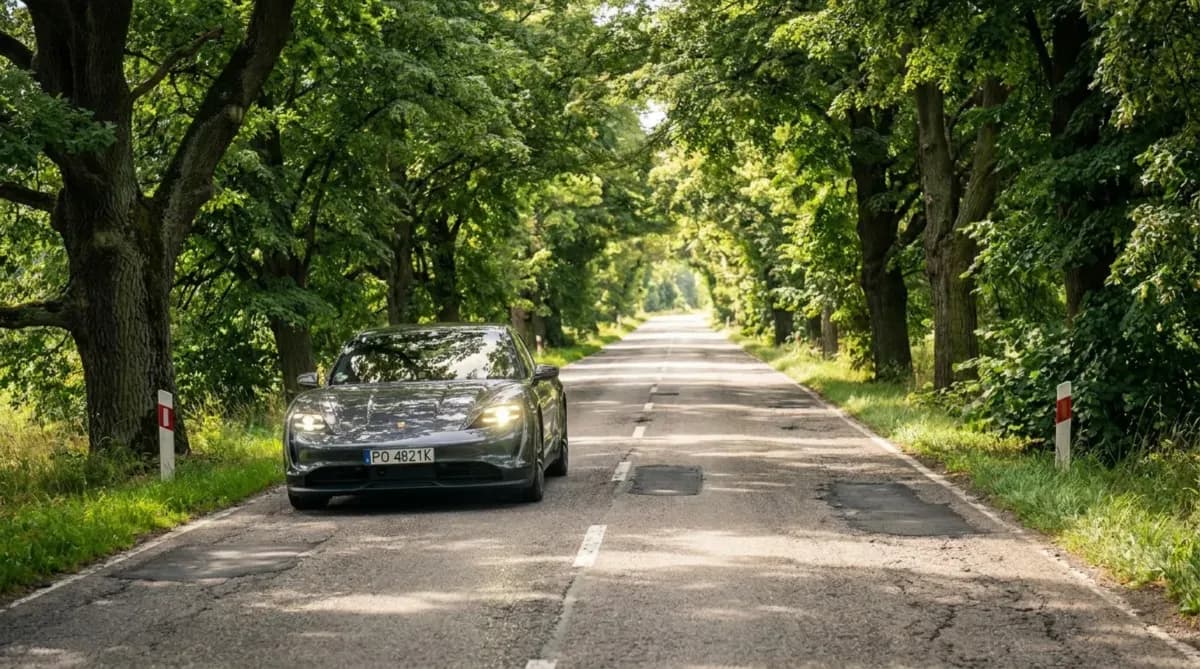
Many secondary routes across Poland feature historic tree-lined avenues, known locally as aleje. While scenic, their overarching branches cast alternating patterns of light and deep shadow across the roadway on sunny days.
Overtaking on these routes without headlamps is dangerous. Low beams prevent approaching traffic from vanishing into the flickering shadows, ensuring you maintain a clear visual grasp of oncoming vehicles on narrow corridors.
When Must You Use Low-Beam Headlights in Poland?
Driving After Dark
Low-beam headlights, referred to as światła mijania in Polish, are mandatory from dusk to dawn. Under Polish traffic law, darkness is defined as the point when ambient daylight is insufficient to clearly distinguish objects and road hazards without artificial illumination.
Relying on DRLs after sunset isn't just illegal-it's unsafe. Low beams cast an asymmetrical beam pattern roughly 40 to 50 meters forward without blinding oncoming drivers. Crucially, selecting low beams also activates your rear position lights, ensuring vehicles behind you can gauge your position.
Reduced Visibility Caused by Rain, Snow, Fog, or Haze
Drivers must manually switch from daytime running lights to low beams whenever weather reduces ambient clarity. This includes sudden summer storms, winter snowfall, dense morning fog, and heavy industrial haze.
A reliable standard to follow is your windshield wipers: if rainfall requires continuous wiper operation, or if mist obscures the horizon, turn on your low beams. This illuminates the road directly ahead while ensuring your tail lamps cut through spray to protect your vehicle from behind.
Tunnels, Unlit Roads, and Difficult Conditions
You must activate low-beam headlights whenever entering a road tunnel in Poland, which are indicated by sign D-9. This requirement applies regardless of whether the tunnel interior features overhead lighting. Daytime running lights are never legally sufficient inside tunnels.
Unlit rural roads and poorly illuminated peripheral zones also demand the broad, focused beam of low headlights. They reveal low-contrast road obstacles, including wildlife, cyclists, and pedestrians using gravel shoulders.
When Daytime Running Lights Are Not Enough
Daytime running lights are designed solely to make your car visible to others in clear daylight-they don't project usable light onto the road. Modern dashboards frequently illuminate automatically, which can mislead drivers into assuming their main exterior lights are active when they aren't.
DRLs are dangerous in heavy highway spray or dim twilight because they leave the rear of your car dark. Without active tail lamps, an approaching vehicle traveling at higher speeds may identify your car too late to brake safely.
Can Daytime Running Lights Replace Low Beams?
When DRLs Are Permitted
Daytime running lights (światła do jazdy dziennej) are legally permitted as an alternative to low beams only during clear daylight hours between dawn and dusk. Vehicles with factory-fitted DRL systems can operate them on all road types, including dual carriageways, expressways, and urban streets, as long as visibility is normal.
Aftermarket DRL installations are legal provided they comply with European ECE R87 regulations and display the molded "RL" approval mark on the lens. Non-compliant DIY light strips or modified auxiliary lamps don't meet legal standards, leaving you liable for traffic fines and the potential seizure of the vehicle's registration certificate.
Rear Lighting Differences Between DRLs and Low Beams
The primary functional difference between DRLs and low beams involves the tail lamps. Under standard European automotive specifications, daytime running lights operate exclusively at the front of the vehicle, leaving the rear lights off.
While this configuration reduces energy consumption, it creates hazards if you forget to adjust the light controls when conditions change. A vehicle driving through highway spray with front DRLs remains completely unlit from behind, blending into the cloud of mist and increasing rear-end collision risks.
Why DRLs Cannot Replace Low Beams at Night
Using DRLs at night creates hazards for everyone on the road. Because their light elements are designed to scatter light across wide angles to catch attention during the day, they create sharp glare for oncoming traffic in the dark.
Furthermore, DRLs offer virtually zero focused road surface illumination. Drivers operating on DRLs at night can easily miss road hazards, potholes, or pedestrians until it's too late to stop safely.
How Should You Use Headlights in Rain, Fog, and Snow?
Lights for Rain and Wet Roads
Wet asphalt behaves like a mirror, reflecting ambient streetlamps and headlights while tires kick up thick clouds of mist and road grime.
Drivers must manually engage low beams in wet weather. The low-beam optic directs light downward onto the tarmac, reducing backscatter from raindrops. At the same time, the rear red lights ensure following traffic spots your vehicle early through heavy highway spray.
Lights for Fog and Limited Visibility
Fog consists of suspended water droplets that act as microscopic reflectors. Switching to high beams in thick fog is counterproductive; the concentrated light bounces straight back into your eyes, creating a blinding white wall.
Maintain low beams in these conditions. If your vehicle is equipped with front fog lights (przeciwmgłowe przednie), turn them on as needed. Positioned close to the ground, they project a broad, flat beam that slides beneath the fog bank to illuminate lane markings and shoulder edges with minimal glare.
When Rear Fog Lights Are Allowed
Rear fog lights (przeciwmgłowe tylne) emit an intense red glare significantly brighter than standard tail lamps or brake indicators. Polish traffic law strictly restricts their use to situations where visibility drops below 50 meters.
Activating rear fog lights in light drizzle, moderate mist, or dense urban traffic is illegal and dangerous. The intense red light dazzles following motorists, masking your brake lights and causing eye fatigue. You must switch off rear fog lights as soon as visibility improves beyond 50 meters.
When Can You Use High Beams in Poland?
Using High Beams on Dark Roads
High-beam headlights, known in Poland as światła drogowe or colloquially as "long lights" (długie), are permitted on unlit roads from dusk to dawn. Their long-range projection illuminates distant bends, stationary road obstacles, and animals crossing the road.
You may only activate high beams when doing so doesn't endanger or blind other road users. They offer valuable reaction time along unlit countryside routes and dense forest sectors.
When to Switch to Low Beams for Other Road Users
Polish law requires drivers to dim high beams immediately when facing approaching traffic to avoid blinding oncoming motorists.
You must also switch back to low beams when following another vehicle, as your high beams reflect directly off their interior and side mirrors. Additionally, you're required to dim your lights if they risk blinding pedestrians traveling in organized groups, cyclists, or operators of watercraft and rail transport running parallel to the roadway.
High-Beam Restrictions in Built-Up Areas
Built-up zones (obszar zabudowany), marked by rectangular white signs featuring a black urban skyline (sign D-42), carry strict high-beam restrictions. Because urban roads feature street lighting, complex intersections, and frequent pedestrian activity, high beams are rarely appropriate.
You may only use high beams in a built-up area if the road section is entirely unlit and you won't cause glare to other motorists, cyclists, or pedestrians. If municipal streetlights are operating, keep your high beams off.
How to Avoid Glare and Unsafe Headlight Use
Using high beams responsibly requires active anticipation. As you approach crests or blind corners, scan the tree lines and crash barriers for the reflected glow of oncoming headlights, dropping to low beams before the oncoming car enters direct view.
If an approaching motorist forgets to dim their high beams, don't stare directly into the glare. Shift your gaze down and toward the solid white edge line on the right shoulder. This helps preserve your night vision while keeping your car tracking securely in its lane.
What Common Headlight Mistakes Should Drivers Avoid?
Using Position Lights Instead of Low Beams
Some drivers mistakenly operate vehicles using only position lights (światła pozycyjne), commonly known as parking lights. These low-wattage bulbs are designed to mark a stationary or disabled vehicle at the roadside; they don't produce enough light for active driving.
Driving on position lights alone violates Polish road regulations, leaves the road ahead unlit, and fails to make your car sufficiently visible to cross traffic. Traffic police routinely stop vehicles driven this way.
Leaving DRLs On During Night Driving
Modern backlit instrument clusters and bright touchscreen consoles stay illuminated regardless of exterior switch settings. This leads some motorists to drive after dark assuming their full lighting system is active, when only their low-intensity front DRLs are engaged.
This oversight is especially dangerous on motorways and expressways, where trailing traffic closing at 140 km/h may not see an unlit rear end until they're dangerously close. Always verify that your switch is turned to low beams as soon as natural light starts to fade.
Using Rear Fog Lights Without Dense Fog
Misusing rear fog lights remains a frequent frustration on Polish roads. Many drivers flip the switch at the first sight of autumn rain or leave it active while idling in highway traffic jams, blinding everyone behind them.
Always respect the 50-meter threshold. If you can clearly see the taillights of the car ahead or spot the red-and-white roadside delineator posts, visibility is well above 50 meters. Since Polish highway delineators stand exactly 100 meters apart, they serve as a practical measuring tool-if you can see the next post, leave your rear fog lamp off.
Relying on Automatic Headlight Settings Without Checking Them
Most modern vehicles feature an "AUTO" light function connected to ambient light sensors on the windshield. While convenient, these systems primarily measure darkness rather than atmospheric visibility. They often fail to register daytime rain, ground-level mist, or light snow showers.
Consequently, your car might run front DRLs during a persistent rainstorm while your rear lamps stay completely off. Take manual control of the switch whenever weather conditions deteriorate.
How Should You Check Your Vehicle's Lighting Before Driving?
Check Low Beams, DRLs, and High Beams
A fast lighting inspection should be part of your regular vehicle routine. Pull up facing a pale wall or garage door, turn on the ignition, and run through the settings: verify the DRLs, switch over to low beams, engage the high beams, and test the hazard signals.
To inspect your tail lamps and brake lights without assistance, reverse toward a wall or commercial glass storefront and monitor the reflections in your rearview mirrors. Alternatively, you can rest a secure object, like an ice scraper, against the brake pedal while inspecting all three brake lights, including the high-mounted center lamp. Ensure the vehicle is parked safely in gear or park with the handbrake fully engaged before stepping out.
Clean Headlamp Lenses and Reflectors
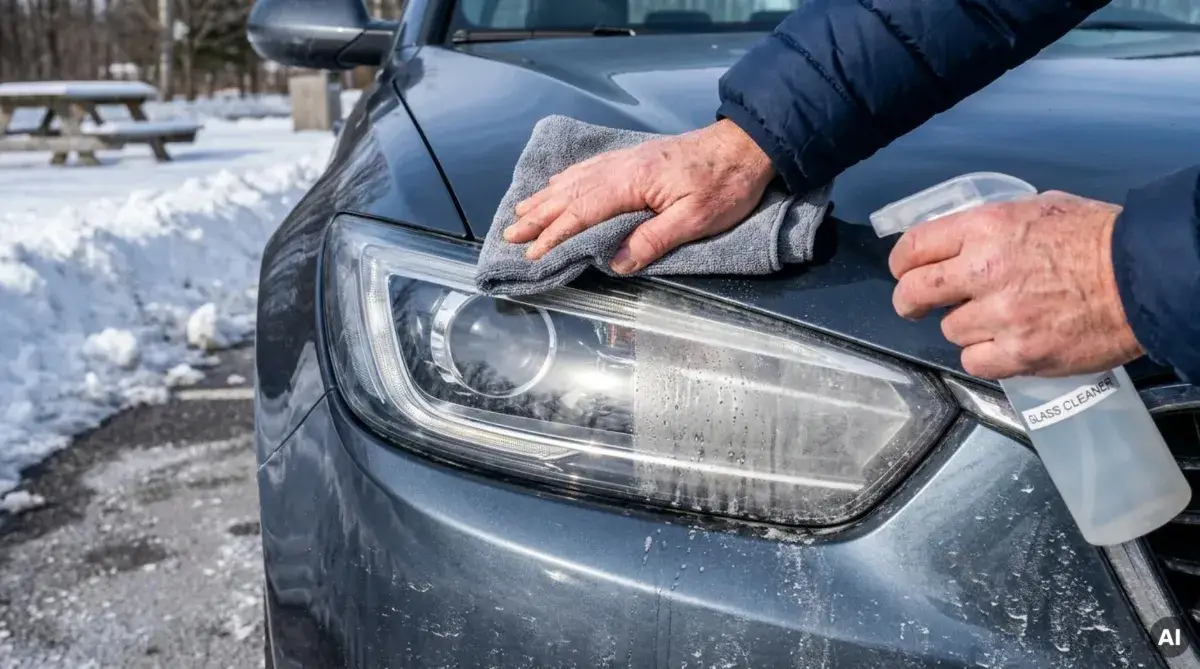
Road grime, dried salt crusts, and mud can cut headlight output by over 50 percent, severely shortening your effective sightline at night. During Polish winter driving, passing trucks can coat your lights in a salty film within just an hour on the motorway.
Clean your headlamp covers with a microfiber cloth and washer fluid during service station stops. On older cars with oxidized or yellowed polycarbonate lenses, using a lens restoration kit or booking a professional polish will restore factory beam clarity.
Confirm Headlight Alignment and Bulb Condition
Proper headlight alignment is just as critical as clean lenses. Headlights aimed too high blind approaching motorists, while beams pointed too low illuminate only the pavement right in front of the bumper, leaving road signs and pedestrians unseen.
Loading luggage into the trunk or carrying several passengers lowers the vehicle's rear stance. Use the manual headlight leveling roller-typically located on the lower dashboard to the left of the steering wheel-to drop the beam angle back to normal. If your car uses halogen bulbs, consider replacing them in matched pairs every two years, as their output degrades with age. This is one more reason to choose a modern, well-maintained rental fleet rather than an older vehicle.
What to Do When a Headlight Fails on the Road
An inoperative headlight constitutes a vehicle defect under Polish law. If an exterior bulb burns out during your journey, traffic police expect you to address the problem immediately if it's safe to do so.
Keep a spare bulb kit and basic tools in your glove compartment. If a bulb fails on an expressway or motorway, pull into the nearest MOP (passenger service area) or illuminated service station to swap it out. If tight engine bay packaging prevents roadside replacement, proceed directly to the nearest auto repair facility with your low beams engaged.
What Are the Penalties for Driving Without Required Lights?
Fines for Driving Without Headlights
The Polish traffic police (Policja) strictly enforce lighting rules across the national road network. Operating without mandatory lights during daytime hours carries a standard fine of 100 PLN, whether you forgot to engage your low beams or your vehicle lacks compliant DRLs.
Penalties increase if the violation occurs in higher-risk environments. Failing to use mandatory lighting between dusk and dawn, or inside a designated tunnel, results in a fixed fine of 200 PLN.
Penalties for Incorrect Lighting
Police will also ticket motorists for using their lights incorrectly. The official Polish fine schedule (taryfikator mandatów) outlines the following penalties:
Incorrect use of fog lights: Operating rear fog lamps when visibility exceeds 50 meters, or running front fog lamps on clear roads outside designated winding routes, carries a 100 PLN fine.
Dazzling other drivers: Blinding oncoming or following traffic with high beams brings a 200 PLN fine.
Driving on position lights: Using only parking or position lights instead of low beams results in a 100 PLN fine.
Improperly illuminated load: Transporting cargo that obscures exterior lamps or reflectors leads to fines between 150 and 200 PLN.
Potential Penalty Points and Police Checks
In addition to financial penalties, drivers face penalty points (punkty karne). Driving without required daytime lights adds 2 penalty points to your record. If the offense happens after dark or within a tunnel, the penalty increases to 4 to 6 points, depending on the severity of the situation.
Accumulating 24 penalty points-or 20 points for new drivers within their first year of licensing-results in an automatic suspension of driving privileges. For foreign motorists, points are logged in a national police database; reaching the penalty threshold leads to an immediate driving ban within Polish territory.
Why the Exact Fine Can Depend on the Violation
While the fine schedule establishes base rates, officers assess the broader context of each violation. If traveling without lights forces an oncoming vehicle to brake hard or swerve, or occurs during a heavy snowstorm, the officer can issue a more severe citation for creating a direct road hazard.
If an essential lighting component is damaged and cannot be repaired on the spot, officers may electronically confiscate the vehicle's registration certificate. The vehicle is deemed unroadworthy, and while the driver may receive a temporary permit to drive directly to an inspection facility, the car cannot be operated normally until it passes an official technical inspection.
What Should Foreign Drivers Know About Headlights in Poland?
Headlight Rules for Tourists and Rental Cars
If you're picking up a car rental at major transport hubs like Warsaw Chopin, Kraków-Balice, or Gdańsk Lech Wałęsa, take a minute to check the lighting controls before driving off. Modern fleet models feature automatic lighting controls, but you should still confirm whether your vehicle uses standalone DRLs or continuous low beams.
Don't rely solely on automated sensors in stormy weather. Familiarize yourself with the dashboard indicators: a green icon with two opposing small lamps indicates position lights, while a green headlamp icon pointing left with downward rays confirms your low beams and rear lights are active.
Driving Across Poland's Borders
Traffic regulations change as you cross European borders. Drivers crossing into Poland from Germany transition from a network where daytime lights are merely recommended for passenger cars to one where daytime lighting is strictly mandatory every day of the year.
Traveling south into Slovakia or the Czech Republic means maintaining mandatory daytime lights, whereas other neighboring countries apply seasonal rules or require lights only on specific highways. Adjust your habits the moment you cross the Polish border to ensure a smooth journey without traffic interruptions.
Vehicle Lighting Requirements for Motorcycles
Riders touring Poland must operate their front lighting continuously. Polish law provides no daytime exemptions for vintage, classic, or custom motorcycles.
Keep your headlamp clean from insects and road grime, particularly after long highway stretches. Because a motorcycle relies on a single forward lamp to stand out against roadside backgrounds, clean and properly aimed lights are essential for comfortable travel and safety at busy rural intersections.
Why Drivers Should Check Current Polish Regulations
Automotive regulations and road enforcement practices continue to adapt alongside lighting technologies like adaptive driving beams, matrix LED units, and automated software controls. Polish authorities routinely harmonize domestic inspection standards with broader European Union directives.
Before setting off on an extended road trip across Poland, review current highway guidelines via the General Directorate for National Roads and Motorways (GDDKiA) or national motoring clubs. Make sure your vehicle carries all legally required safety items, including a warning triangle and reflective safety vests for the driver and passengers, so you can enjoy stress-free travel wherever your journey takes you.