
16.09.2026
Parking in Poznań: Old Market Square and Beyond
Where can you park near Poznań's Old Market Square without facing fines or traffic delays? While motor vehicles can't enter the historic cobbled center, several secure underground garages, paid street spots, and Park & Ride hubs sit within a 5- to 10-minute walk of Stary Rynek.
Understanding the city's parking zones, access gates, and transit options ensures a smooth journey and stress-free travel from the moment you arrive.
Where To Park in Poznań Near the Old Market Square
Finding a parking spot near Stary Rynek comes down to balancing walking distance with convenience. Because the square is reserved entirely for pedestrians, you'll want to focus on the ring roads and designated parking facilities circling the Old Town rather than trying to enter the center.
The surrounding neighborhoods offer practical choices depending on whether you need a space for a quick lunch, a full afternoon of sightseeing, or an overnight stay. Chwaliszewo borders the Warta River to the east, Garbary sits to the northeast, and the area surrounding Plac Wolności extends west toward the commercial center.
Paid Street Parking Around Stary Rynek
Curbside spaces on streets like Garbary, Dominikańska, Wielka, and Małe Garbary belong to Poznań's central paid parking zone. They put you just minutes from the historic lanes leading to the square, making them handy for short stops. However, turnover is high and demand peaks during lunch hours and warm evenings.
If you don't find a spot immediately, it's better to head straight to an off-street lot than to circle the block repeatedly. Always check the curb signs for resident permits or commercial loading zones, and park strictly within marked white lines. Municipal parking wardens patrol these streets regularly.
Car Parks Within Walking Distance of the Old Market Square
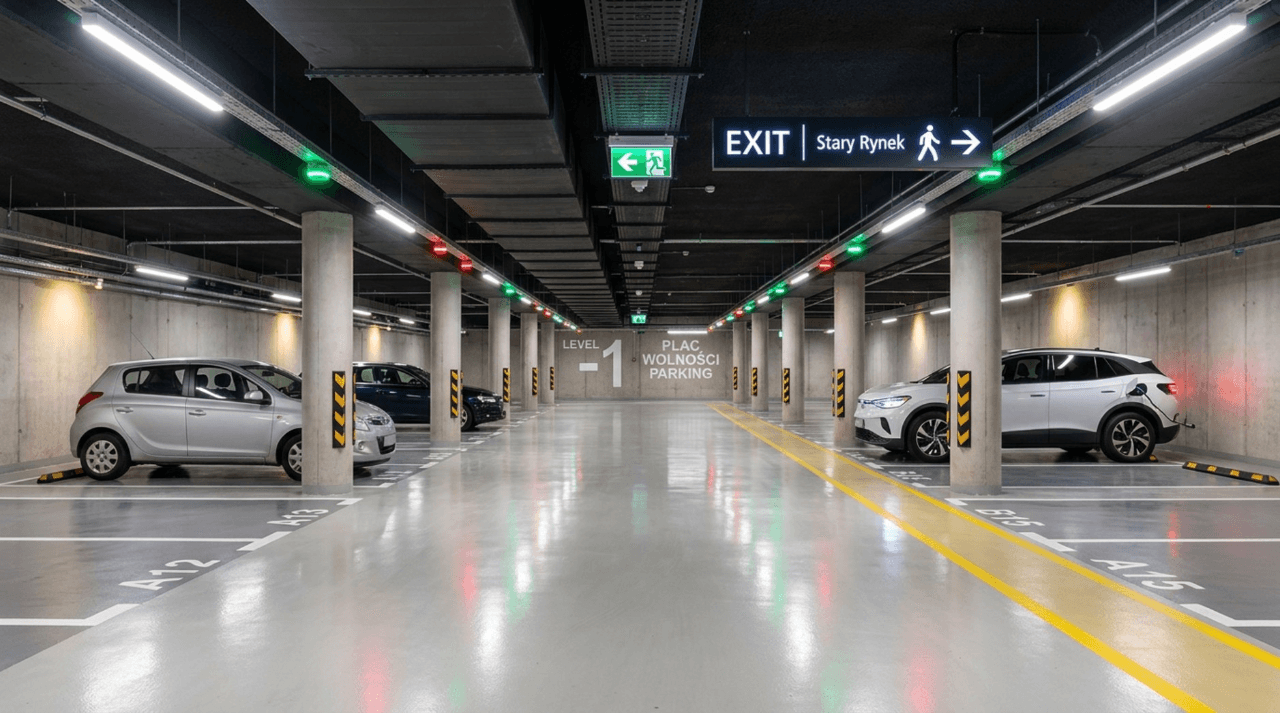
Underground and multi-story parking garages offer a more dependable alternative to street parking. The largest and most popular facility sits directly beneath Plac Wolności (Freedom Square). It's roughly a five-minute walk from Stary Rynek and provides hundreds of underground spaces, automated payment kiosks, and 24/7 video monitoring.
Other reliable choices include surface and partially sheltered lots along Chwaliszewo and Stawna Street, as well as the underground garage at the Kupiec Poznański center. While garage rates can be slightly higher than curbside meters, they keep your vehicle sheltered from winter snow or summer heat and save significant time.
Park-And-Ride Options for Central Poznań
If you prefer to bypass inner-city traffic altogether, Poznań's Park & Ride (P+R) network is an excellent choice. These facilities are positioned alongside major transit routes on the city outskirts, such as the Szymanowskiego lot along the northern fast tram corridor and Rondo Starołęka in the south.
Poznań's P+R lots integrate directly with the municipal transit system. Drivers holding valid transit tickets or combined parking-transit passes can often park at reduced rates or free of charge. From there, modern, low-floor trams take you to the city center in about 10 to 15 minutes without congestion delays.
Coach Parking Lots for Group Travel
Travel groups arriving by coach must follow separate municipal regulations. Tour buses can't use standard passenger car spaces. Designated pick-up and drop-off zones are available on major perimeter roads, including ul. Garbary and near the National Museum, allowing passengers to disembark safely before the coach moves to long-term storage.
Dedicated long-stay coach parking is located farther out, primarily near Lake Malta and around the Poznań International Fair (MTP) grounds. Tour operators should consult the Poznań Municipal Road Authority (ZDM) map before arrival to verify current bay locations and avoid stopping penalties.
Can You Drive to Poznań Old Town?
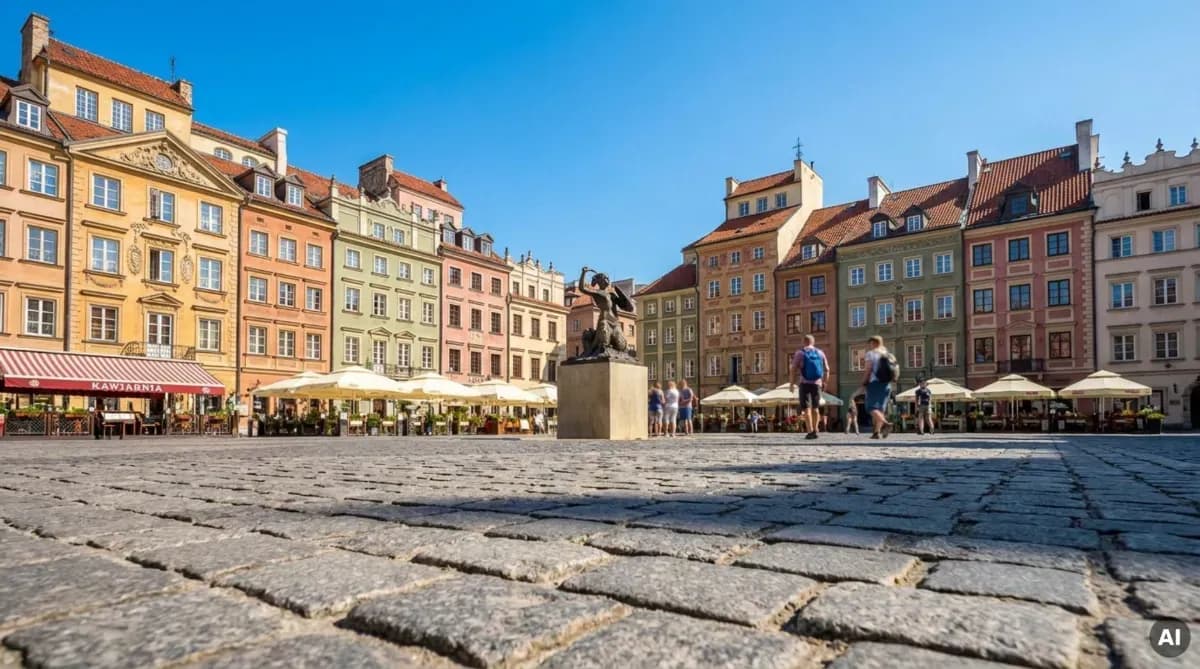
In short: you can only drive up to the edge of the historic district. Poznań has transformed its historic core into a pedestrian-first zone, dedicating the streets around Stary Rynek to foot traffic, open-air dining, and cultural events.
Attempting to drive onto the square or into adjoining historic lanes without an official city permit will lead you to rising bollards, automated enforcement cameras, or a municipal police checkpoint. Knowing where general access ends will save you unnecessary frustration.
Vehicle Access Restrictions Around Stary Rynek
A Restricted Access Zone covers Stary Rynek and its historic side streets, such as Wrocławska, Żydowska, and Kramarska. Standard motor vehicle traffic is banned 24 hours a day. Exceptions apply only to emergency vehicles, municipal maintenance teams, residents with documented private courtyard access, and authorized delivery drivers during morning windows.
The boundaries are clearly marked with standard “No Vehicles” signs and supplementary informational plaques. Standard private vehicles and car rental bookings don't carry automatic entry rights, and unauthorized entry is tracked by cameras and regular patrols.
Pedestrian Streets, Bollards, and Permitted Access Times
Poznań uses automatic retractable steel bollards to protect pedestrian areas. These bollards lower only when an authorized RFID card, remote transponder, or registered license plate is verified by the system. Some entry points also feature an intercom connected to municipal monitoring services.
Certain pedestrian arteries, like sections of ulica Półwiejska and ulica Wrocławska, permit commercial deliveries during designated morning hours before closing to all vehicular traffic for the remainder of the day. Never attempt to tailgate an authorized vehicle over a lowered bollard; the posts raise automatically and can cause severe undercarriage damage to your vehicle.
Accessible Parking for Visitors With Disabilities
Drivers with mobility challenges displaying a valid European Parking Card (blue badge) receive dedicated parking privileges across Poznań. Designated accessible bays, marked in bright blue and known locally as koperty, are placed near key destinations, including Plac Kolegiacki, Garbary, and Plac Wolności.
In municipal paid zones, registered blue badge holders can generally use these marked accessible spaces free of charge when the permit is clearly displayed behind the windscreen. Always review the local zone regulations posted on the nearest meter if all marked accessible spaces are occupied, as conditions for standard bays can vary.
Loading, Unloading, and Hotel Drop-off Rules
If you've booked a hotel or serviced apartment within the pedestrian zone, you'll need to coordinate your luggage drop-off ahead of time. Many hotels inside the restricted perimeter can arrange temporary 10- to 15-minute access for guests to unload bags, but the property must register your vehicle's license plate with city authorities beforehand.
Don't assume you can drive up to the hotel doors unannounced. Contact your accommodation before you arrive so the front desk can provide the designated access gate, the correct approach route, and clear instructions to keep your visit penalty-free.
Parking Zones, Hours, Rates, and Payment Methods
Street parking in Poznań is regulated by the Zarząd Dróg Miejskich (ZDM) through distinct paid parking zones. Hourly rates are higher near the center, and operating hours are longer in high-demand areas to maintain parking turnover throughout the day.
Understanding zone boundaries and accepted payment methods helps you avoid unexpected penalty fees and plan your day with confidence.
How Poznań Parking Zones Work
The city operates two primary types of on-street paid parking: the Downtown Paid Parking Zone (Śródmiejska Strefa Płatnego Parkowania, or SSPP) and the standard Paid Parking Zone (Strefa Płatnego Parkowania, or SPP). The SSPP covers the Old Town and the bustling Jeżyce district, where street space is at a premium.
The central red zone (Centrum) carries the highest hourly fees and the longest operational hours. Moving outward into the yellow and green SPP zones-such as Wilda and Łazarz-rates decrease, and payment windows end earlier, offering more economical parking within a short tram ride of the center.
How To Check Parking Rates and Operating Hours
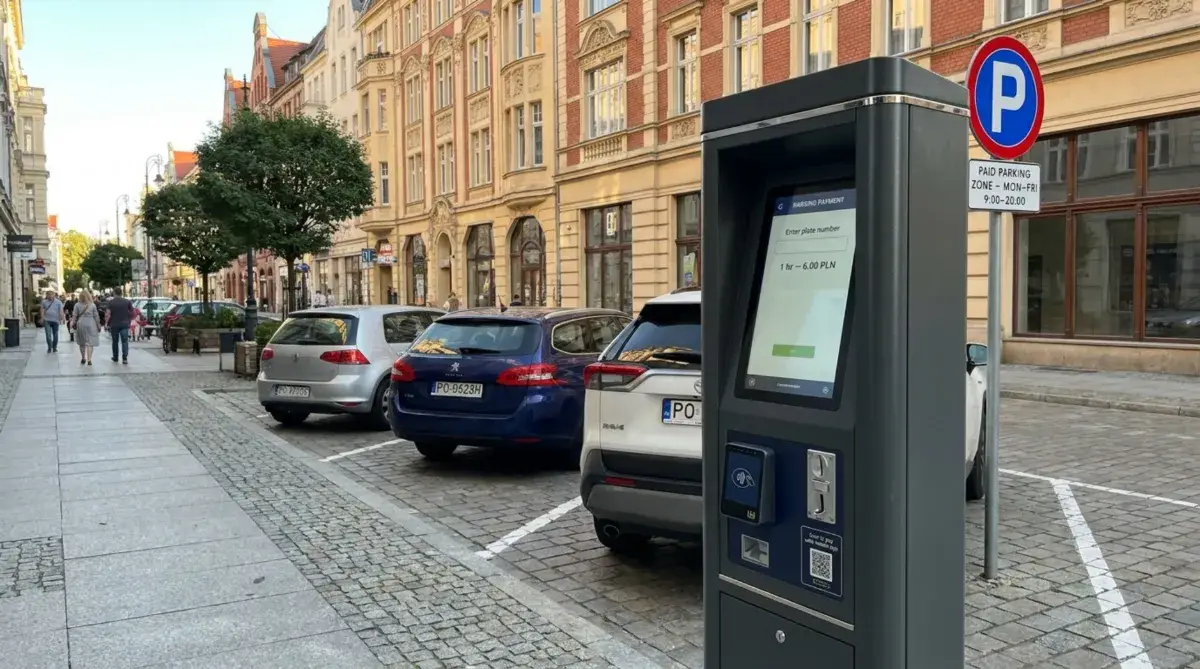
Every street parking meter (parkomat) displays the applicable hourly rate, operating schedule, and zone designation. In the central SSPP zone, payment is generally required Monday through Friday from 08:00 to 20:00, and on Saturdays from 08:00 to 18:00. Street parking is typically free on Sundays and official public holidays.
Rates are progressive, meaning the second and third hours often cost more than the first to discourage long-term curbside parking in core retail zones. Always verify the rates displayed on the machine near your vehicle, as city authorities update zone boundaries periodically.
Mobile Parking Apps, Meters, Cards, and Cash
Paying for parking in Poznań is straightforward. Street meters accept contactless debit and credit cards, Polish BLIK mobile payments, and standard Polish złoty coins. Keep in mind that cash-operated meters do not provide change.
For greater flexibility, many drivers use certified parking apps like moBILET, SkyCash, mPay, or Flowbird. These apps allow you to start and stop parking sessions remotely by the minute, ensuring you only pay for the exact time you use without rushing back to feed the meter.
What Parking Signs and Restrictions Mean
Polish road signs follow standard European conventions. A blue rectangular sign with a white “P” (sign D-18) indicates permitted parking, often accompanied by sub-panels illustrating whether the vehicle must sit entirely on the road, straddle the curb, or park fully on the pavement.
Pay close attention to sign B-35 (Zakaz postoju / No Parking beyond a short stop) and sign B-36 (Zakaz zatrzymywania się / No Stopping). A supplementary tow-away sign (T-24) beneath either restriction indicates that unattended vehicles will be impounded at the owner's expense.
How To Avoid Parking Fines and Vehicle Removal
Poznań enforces parking compliance via municipal police (Straż Miejska) foot patrols and automated camera cars equipped with license plate recognition systems. These mobile camera units scan parked vehicles in real time and cross-reference them against active digital payments.
To avoid an additional fee notice (opłata dodatkowa), double-check that you've entered your license plate correctly into the meter or mobile app, including all letters and numbers. Certain parking app providers may require an identifying dashboard card or note; follow the specific instructions inside your chosen app.
How to Find an Available Parking Space in Poznań
Searching for curbside parking around central Poznań on a busy afternoon can consume valuable time. Fortunately, the city provides digital tools and real-time guidance displays to help you find an available space quickly and enjoy a smooth journey.
Planning your parking strategy around smart navigation data makes arriving in the city center far more convenient, even during peak travel seasons.
Live Parking Maps and Navigation Apps
Navigation platforms like Google Maps, Apple Maps, and Waze offer live traffic tracking across central Poznań. In addition, the city has installed dynamic electronic variable messaging signs along major approach corridors-such as ul. Solna, ul. Królowej Jadwigi, and ul. Roosevelta-displaying real-time bay availability at large garages like Plac Wolności.
Municipal parking portals and smart mobility apps also track data from street sensors in selected districts, showing current occupancy levels directly on your smartphone screen.
Color on the Map Indicates the Chance of Finding Parking Right Now
Real-time parking maps typically use standard color indicators to show parking availability. A green indicator means occupancy is low, indicating a strong likelihood of finding an open curbside bay right away.
Yellow or amber signals moderate occupancy, meaning you might need to check adjacent streets before a spot opens up. When central areas turn red or maroon, curbside spaces are almost entirely occupied. In that scenario, steer directly toward an underground garage to avoid circling through downtown congestion.
What To Do When Old Town Parking Is Full
If the immediate streets around Stary Rynek and the Plac Wolności garage report full occupancy, don't wait in roadway queues. Shift your focus to alternative facilities located just outside the core.
The large multi-story garage at the Stary Browar retail and arts center provides an ideal backup, located roughly a 10-minute walk from the Old Market along pedestrianized Półwiejska Street. Alternatively, consider the paid parking areas across the river in Ostrów Tumski or Śródka, both of which offer pleasant walking routes or quick tram connections back into the center.
Should You Bring a Car to Poznań?
Poznań features a compact, walkable historic core complemented by an extensive public transport network. Whether having a car is beneficial depends entirely on your broader itinerary across Poland.
If your plans focus solely on downtown dining, museums, and historical landmarks, walking and public transit will serve you well. However, if you want the freedom to travel into the surrounding region, having a car gives you far greater flexibility.
When a Car Is Useful in Poznań
A reliable vehicle is invaluable if you plan to explore the Greater Poland (Wielkopolska) countryside, where regional rail connections are limited. Top day-trip destinations within easy reach include the neo-Gothic castle in Kórnik, the historic Rogalin Palace with its ancient oak groves, and the scenic trails of Wielkopolski National Park.
Driving is also practical for business travelers carrying demonstration equipment to the Poznań International Fair (MTP) and for families traveling with young children and extra luggage who value comfortable travel between multiple cities. If you're arranging a rental car in Poznań for these excursions, booking ahead ensures a smooth pickup before you head out of the city.
When Public Transport Is Easier Than Central Parking
For daily travel strictly within Poznań’s inner districts-such as exploring the Art Nouveau architecture of Jeżyce or visiting Cathedral Island-trams are often simpler than driving. Poznań’s modern tram fleet runs frequently, operates on dedicated tracks that bypass peak rush-hour traffic, and features air conditioning on most routes.
When you factor in parking meters, commercial garage fees, and navigating central one-way systems, a 24-hour or 72-hour ZTM Poznań transit pass provides an economical, hassle-free way to move across the city center.
Public Transport Connections From Park-And-Ride Facilities
Poznań’s P+R facilities connect directly with high-frequency transit lines. The backbone of the northern network is the PST light rail line (Poznański Szybki Tramwaj, known locally as "PeSTka"). This grade-separated tram route links northern suburban hubs directly to the Poznań Główny central train station and the edge of the Old Town.
Leaving your car at the Szymanowskiego P+R allows you to hop on tram lines 12, 14, 15, or 16 and reach Stary Rynek in under 15 minutes. Stations feature step-free lift access, real-time departure screens, and ticket vending machines for a seamless connection.
[Rent a car at Poznan Airport]
Stary Rynek and Poznań Old Town on Foot
Once your car is parked in a secure underground garage or perimeter lot, you can fully enjoy Poznań’s pedestrian-friendly historic core. Built centuries before the automobile, these cobblestone streets and market squares were designed for walking, dining, and cultural discovery.
Exploring on foot lets you discover quiet courtyards, local artisan shops, and traditional bakeries that you'd easily miss from behind the wheel.
Walking Routes From Nearby Car Parks to the Old Market Square
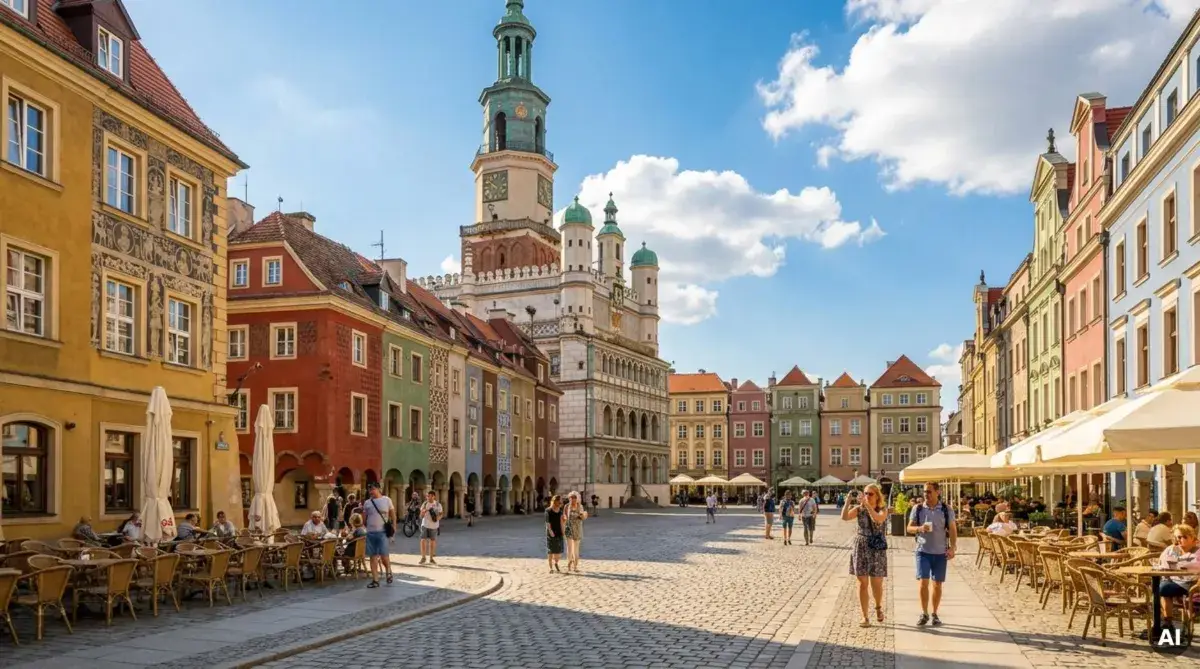
From the underground parking facility at Plac Wolności, walk east down ulica Paderewskiego. This gentle 200-meter descent brings you directly onto the western side of Stary Rynek, opening up an immediate panoramic view of the iconic Renaissance Town Hall.
If you leave your car at the Chwaliszewo surface lots, follow ulica Wielka westward along the former riverbed. This approach takes you past colorful townhouses, specialty coffee bars, and independent boutiques before opening onto the lively market square.
Landmarks, Restaurants, Museums, and Shopping Streets Nearby
The architectural centerpiece of Stary Rynek is the 16th-century Town Hall, originally designed by Italian architect Giovanni Battista di Quadro. Just behind it stands the Parish Church of St. Stanislaus (Fara Poznańska), one of Poland's most magnificent Baroque basilicas, renowned for its grand pipe organ and striking pink stucco facade.
Surrounding streets like Żydowska and Wrocławska offer a wide array of dining, from traditional Polish pierogarnie to contemporary international restaurants and craft beer pubs. For shopping, stroll down the pedestrian corridor of ulica Półwiejska toward Stary Browar, an award-winning retail and cultural complex housed within a restored 19th-century brewery.
How Long To Allow for an Old Town Visit
Set aside at least three to four hours for a proper visit to Stary Rynek and its immediate attractions. This gives you plenty of time to watch the famous mechanical billy goats butt heads above the Town Hall clock at noon and 15:00, tour the Historical Museum, and relax over coffee on the square.
If you want a more comprehensive experience, plan for a full day. You can tour the vaulted cellars of Fara Poznańska, visit the Royal Castle on Przemysł Hill, and stop at a local bakery to sample the city's renowned protected pastry, the St. Martin’s Croissant (Rogal świętomarciński).
Driving Beyond the Old Market Square
While the Old Town is tailored for pedestrians, driving around the broader Poznań metropolitan area is straightforward. Wide arterial roads like National Road 92 and the city's intermediate ring road (II Rama komunikacyjna) make traveling between outer commercial and recreational districts quick and simple.
Having access to a car allows you to explore parks, sports facilities, and cultural attractions located well beyond the city center on your own schedule. A short-term rental covering just a weekend is often enough to combine the Old Town with these outlying sights.
Parking Near Poznań Attractions Outside the Old Town
Lake Malta (Jezioro Maltańskie), located just two kilometers east of the center, offers year-round recreation including the Termy Maltańskie water park, an artificial ski slope, and regatta courses. Generous surface parking is available along Termalna Street and adjacent to the sports complexes, offering straightforward access at modest day rates.
Further east, the New Zoo (Nowe Zoo) sits within an expansive natural forest. It features a spacious paid parking lot right outside the main gates on Krańcowa Street. If you're heading north to explore the military museums and open parkland at Citadel Park (Park Cytadela), you'll find ample curbside parking along Armii Poznań Street.
Frequently Asked Questions
Is parking near the Old Market Square free?
No. Street parking within walking distance of Stary Rynek falls inside the Downtown Paid Parking Zone (SSPP). You must pay for parking during active operating hours, including Saturdays. Street parking is generally free only on Sundays and official Polish public holidays.
Commercial surface lots and private underground facilities, such as the Plac Wolności garage, charge around the clock, seven days a week, including Sundays and holidays.
What is the closest car park to Stary Rynek?
The multi-level underground garage beneath Plac Wolności is the closest dependable commercial parking facility. It sits roughly 300 meters from the Town Hall steps-about a five-minute walk.
Outdoor surface lots along Stawna Street and in Chwaliszewo are located at a similar distance to the north and east, providing convenient open-air alternatives.
Can you park overnight in Poznań?
Yes, overnight parking is permitted on public streets and in commercial garages. On the street, you only pay for the active enforcement window; night hours (typically 20:00 to 08:00) are free.
If you prefer extra peace of mind, weather protection, and continuous surveillance, use an underground garage or a 24-hour guarded lot (parking strzeżony) such as Plac Wolności or Stary Browar for multi-night stays.
Where can you park a campervan or coach?
Due to height, width, and weight restrictions, motorhomes and campervans are poorly suited for inner-city street parking. Camping 22 at Lake Malta is the recommended base, providing dedicated pitches, electrical hookups, sanitary disposal, and direct tram connections into the city.
Tour coaches should use designated drop-off points along perimeter roads like ul. Garbary to unload passengers, then proceed to authorized long-stay bus facilities near Lake Malta or the Poznań International Fair grounds.
Is Poznań Old Town easy to reach without a car?
Yes. Poznań Główny, the city’s primary rail station, offers regular high-speed and intercity connections to Warsaw, Berlin, Wrocław, and Gdańsk. The station is roughly a 20-minute walk or a quick seven-minute tram ride from Stary Rynek.
Local taxis, ride-hailing services, and modern low-floor trams operate throughout the metropolitan area, making it easy to visit central attractions without a car.
What should you do if you receive a parking ticket?
If you receive a penalty notice (opłata dodatkowa) on your windscreen, address it promptly. The ticket provides specific payment instructions, which can be completed via online bank transfer, payment portals, or at the ZDM Customer Service Office.
Paying within seven business days often reduces the penalty amount. If you believe the fine was issued in error-such as an active mobile app session that was overlooked-you can submit an appeal through the official ZDM Poznań website along with your digital receipt or time-stamped proof of payment.