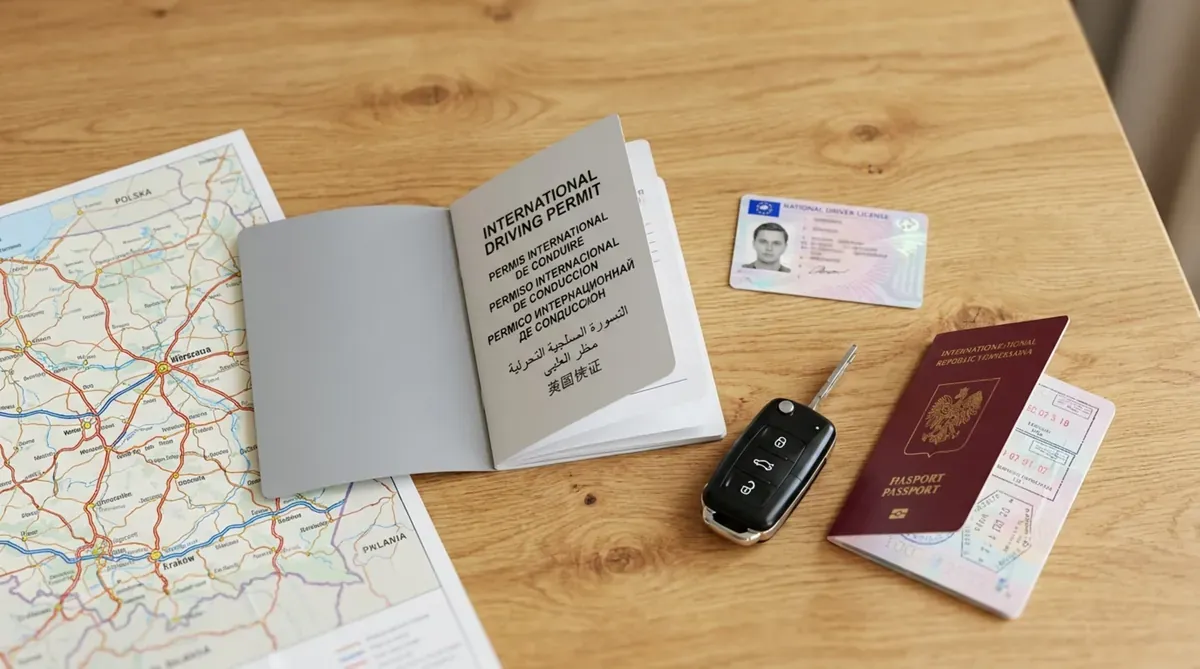

17.09.2026
Polish Police Fines: Can They Really Take Cash on the Spot?
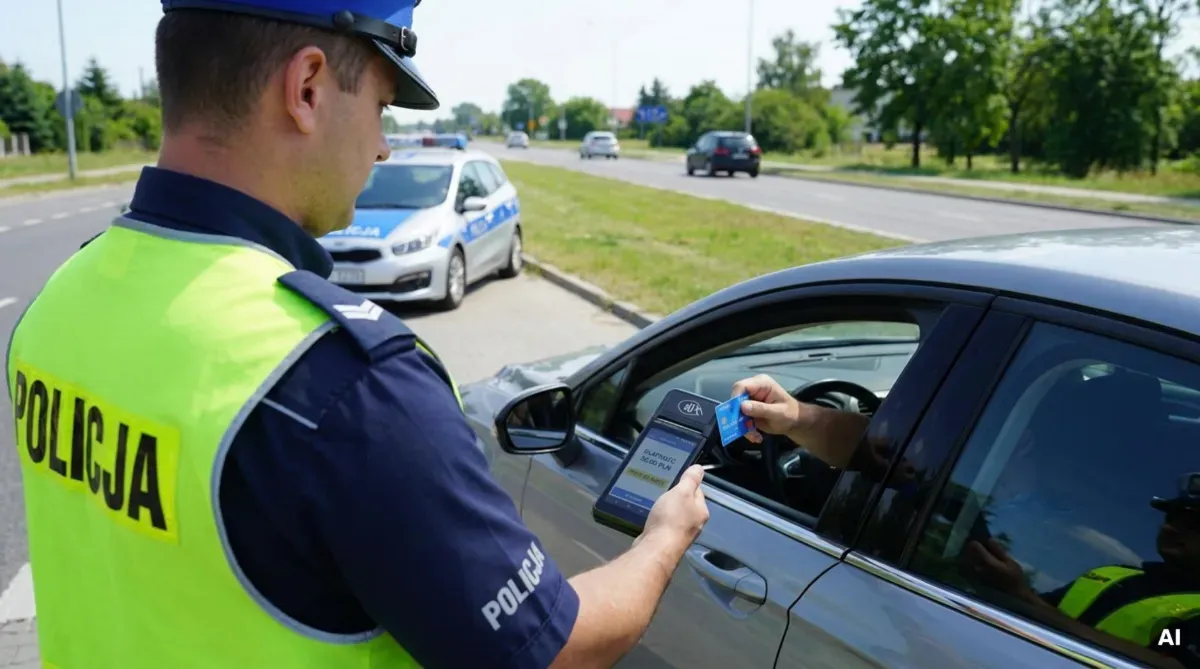
Can Polish police legally demand cash payment for a traffic fine on the spot? Yes, under Article 98 of the Polish Petty Offenses Procedure Code, officers can require an immediate on-the-spot fine (mandat gotówkowy) from drivers who don't have a permanent or registered residence in Poland.
Here's what you need to know about your rights, payment options, and official roadside procedures so you can travel with confidence across the country.
Can Polish Police Take Cash for a Fine on the Spot?
The short answer is yes, but strict legal procedures apply. Article 98 of the Polish Petty Offenses Procedure Code (Kodeks postępowania w sprawach o wykroczenia) establishes this roadside procedure specifically for minor offenses. Pursuing small cross-border traffic fines through foreign courts is complicated and expensive, so Polish law allows officers to conclude the matter during the stop itself.
This process has firm limits and is strictly regulated. An officer can't simply pocket cash and send you on your way. Every roadside transaction requires an official paper ticket, a matching receipt from the officer's serialized ticket book, and an exact legal description of the violation.
When an On-The-Spot Penalty Notice Is Legally Allowed
An immediate cash fine, known as a mandat gotówkowy, applies when officers catch a driver in the act, confirm their identity, and establish that the driver doesn't maintain a permanent address or regular residence in Poland. It primarily affects international tourists, foreign business travelers, and cross-border commercial drivers-including many visitors driving a rental car.
The law also permits immediate payment if a temporary visitor can't provide a verifiable Polish address. In day-to-day enforcement, it ensures that drivers who don't reside in the country settle penalties before leaving Polish territory.
Why Foreigners May Be Asked To Pay Immediately
Cross-border enforcement remains the driving reason behind this rule. While EU-wide agreements help member states exchange vehicle registration details, recovering small traffic debts in another country involves costly, slow administrative hurdles. If a non-resident driver leaves Poland with an unsettled ticket, recovering those funds is exceptionally difficult.
Settling the penalty on the spot eliminates administrative delays and keeps the enforcement process clear. While paying an officer roadside might feel unfamiliar to drivers from countries where this practice is barred, a valid ticket closes the case immediately, preventing future court notices or international collection efforts.
When Police Cannot Demand Cash From You
Police officers can't demand immediate cash if you hold a registered permanent or verified temporary address in Poland. Polish citizens and foreign residents who have a national identification number (PESEL) and registered address (zameldowanie) are issued a credit ticket, called a mandat kredytowany. This gives the motorist seven days to pay via bank transfer.
Officers also can't force an on-the-spot payment if you contest the alleged violation. If you maintain that you didn't commit the offense and refuse to accept the ticket, the officer can't compel you to pay on the road. The case must instead be referred to the local district court (sąd rejonowy).
Cash Payment Versus Card or Bank Transfer
Modern traffic enforcement in Poland relies heavily on digital payment solutions. Most patrol cars operated by the Road Traffic Police (Wydział Ruchu Drogowego) carry mobile point-of-sale (POS) terminals. When issued an immediate ticket, you can usually pay with a debit card, credit card, or contactless options like Apple Pay and BLIK.
Card payments simplify the transaction and provide an immediate electronic bank record alongside the paper ticket. Cash remains an accepted alternative if your card doesn't work or if poor mobile reception prevents terminal connectivity. Officers often prefer card payments because they eliminate handling physical currency.
What Type of Polish Fine Can Police Issue?
Understanding Poland's penalty structure helps you identify what an officer can and cannot do during a traffic stop. Polish law draws clear boundaries between standard roadside tickets, administrative sanctions, and major offenses that require judicial review.
Routine driving infractions are handled through the standard ticket schedule. However, severe violations automatically trigger formal court proceedings where roadside settlements aren't an option.
Traffic Fines Issued Through a Mandat Karny
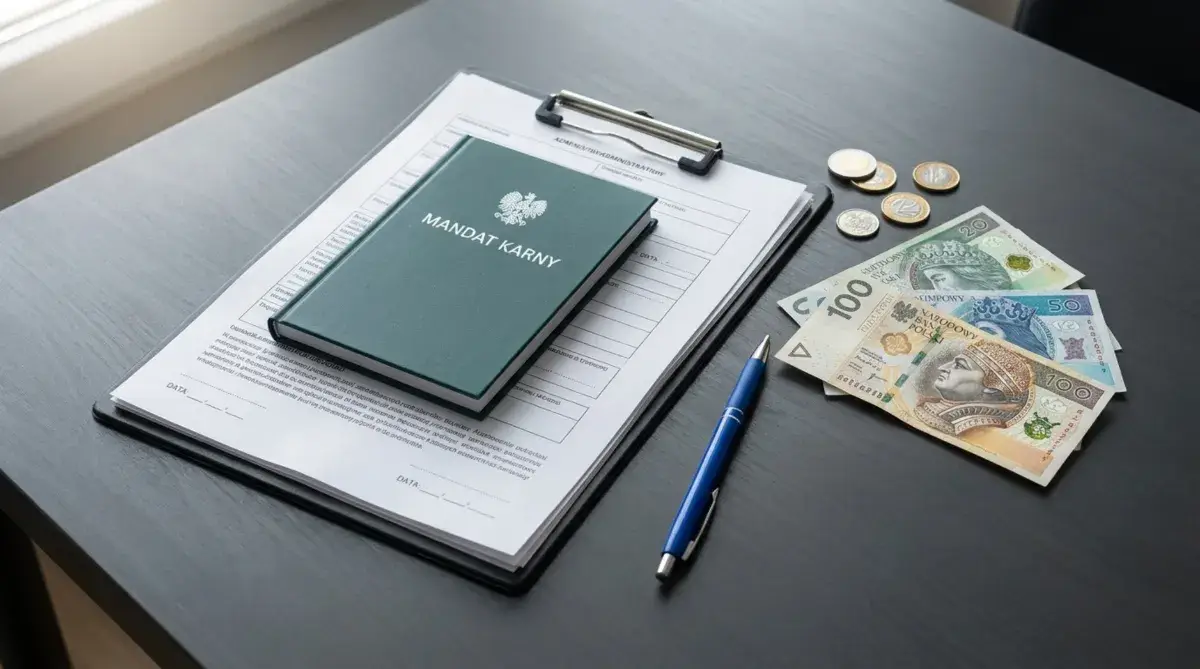
The primary document used during a traffic stop is the mandat karny (penalty notice). This form specifies the offense and the statutory fine. Once you accept it by signing or paying, the summary administrative proceeding concludes.
Every mandat karny strictly follows Poland's national penalty schedule (taryfikator mandatów). This schedule sets fixed amounts or strict fine ranges for speeding, lane violations, failing to yield, and mobile phone use while driving. Because these rates are established by statutory decree, individual officers cannot set arbitrary rates.
Fixed-Amount Penalties Versus Cases Sent To Court
Poland's traffic tariff provides clear fine brackets. For example, speeding penalties scale based on kilometers per hour over the limit, alongside assigned penalty points. While penalty points primarily apply to Polish driving licenses, monetary fines apply equally to all drivers. This structured framework keeps minor traffic penalties predictable.
Officers must refer cases directly to court when an infraction involves severe endangerment, high-level driving under the influence of alcohol or narcotics, or multiple compounded offenses that exceed statutory limits for roadside tickets. Driving while intoxicated is prosecuted as a major offense or crime under the Polish Penal Code.
Administrative Fines and Court-Imposed Penalties
Certain penalties take the form of administrative fines (kary administracyjne). These are typically handled by administrative agencies rather than patrol officers at the roadside. For example, the General Inspectorate of Road Transport (GITD) and regional voivodeship offices process weight violations for commercial haulers and repeated electronic road-toll defaults.
Court-imposed fines occur when a driver rejects a roadside mandat or commits an offense beyond summary ticket limits. District courts have broader discretion to set fines based on circumstances and driver income, and their rulings often include additional court fees.
How the On-the-Spot Fine Process Works in Poland
Lawful police stops in Poland follow clear procedural steps. Knowing what to expect keeps interactions straightforward and helps you verify that an officer is acting according to regulations.
Each phase of the stop is defined by law to ensure transparency, secure proof of payment, and protect your legal rights throughout the process.
Identification, Explanation, and Acceptance of the Fine
When pulling you over, the officer must approach your vehicle, state their rank and surname, and give the clear reason for the stop. Plainclothes officers or those in unmarked vehicles must present an official service ID (legitymacja służbowa) upfront. Uniformed officers are required to display this credential whenever you ask to see it.
The officer will outline the infraction-such as a verified radar reading or improper maneuver-and state the fine dictated by the national schedule. They'll then ask if you agree to accept the ticket. Accepting a roadside ticket is always voluntary; summary proceedings cannot continue without your consent.
What Information Should Appear on the Penalty Notice
A legitimate mandat is a standardized, numbered government document. It must record the date, time, and precise location of the event, your personal and license data, vehicle registration details, and the issuing officer's service badge number.
The document must cite the exact legal foundation under the Road Traffic Law and the Petty Offenses Code. Additionally, it must state the final fine in Polish Złoty (PLN). Any ticket missing these mandatory fields has clear procedural flaws.
Why You Should Request a Receipt or Payment Confirmation
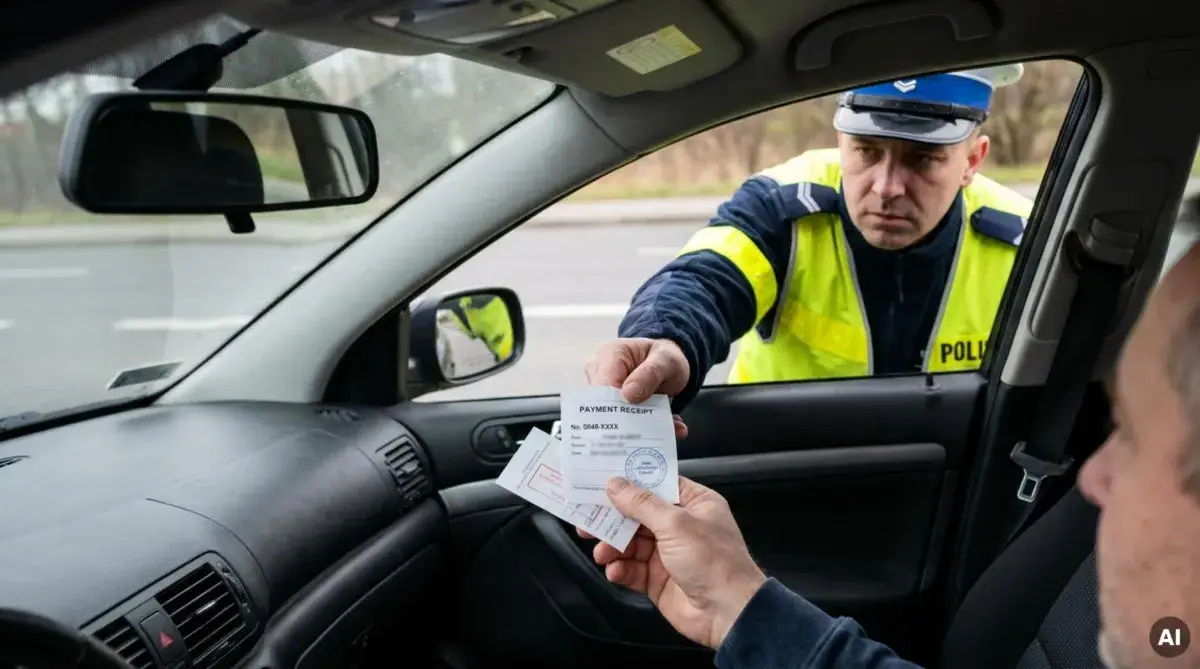
If you settle the fine in cash, the officer must detach and give you an official, serialized counterfoil receipt from their ticket book. This slip must bear an official police stamp and the officer's signature. Never hand over cash without receiving this documentation simultaneously.
When paying by card through the patrol vehicle's terminal, the machine generates two confirmation receipts-one for police files and one for your records. Keep this slip clipped to your ticket copy and vehicle documents to prevent administrative errors later.
What Happens if You Refuse To Accept the Fine
If you disagree with the officer's assessment-such as disputing traffic signal timing or radar accuracy-you have the right to decline the penalty. You can state clearly: "Odmawiam przyjęcia mandatu" (I refuse to accept the ticket).
Officers can't detain you simply for using this legal right, nor can they confiscate funds on the spot. Instead, the officer files a formal motion for sanction (wniosek o ukaranie) with the local district court. For non-resident motorists, the officer verifies identity, notes your international home address, and advises you that court notices will follow.
How Should You Pay a Polish Fine?
Every Polish traffic penalty must be paid via authorized channels that provide clear proof of payment. The proper payment method depends on your residency status and how the infraction was recorded.
Whether settling roadside or later via banking channels, retaining your payment confirmation guarantees a smooth journey without unexpected administrative disputes down the road.
Paying Police Directly by Cash or Card
Non-resident drivers issued an immediate ticket are expected to settle it during the stop. Using an electronic terminal in the patrol car is the most practical method, as it eliminates foreign currency calculations and creates a verified digital banking record.
If you're paying with paper currency, provide the exact sum in Polish Złoty. Police patrols don't operate cash registers and aren't required to carry change for high-denomination bills.
Paying Later by Bank Transfer
Drivers who qualify for a standard credit ticket (mandat kredytowany) receive a multi-part form containing dedicated payment details. You must pay this fine within seven calendar days of issuance, either through an online banking transfer or at a Polish Post Office (Poczta Polska) branch.
National traffic fines flow into a central tax authority account managed by the First Tax Office in Opole (Pierwszy Urząd Skarbowy w Opolu). Most Polish banking apps include a standard "Tax Transfer" (Przelew podatkowy) feature that routes payments directly using your PESEL or ticket reference code.
Paying a Fine Received by Post or From a Speed Camera
Automated camera systems issue penalties by mail; they never involve roadside handoffs. Official correspondence includes an overview of the event, photo evidence summaries, an inquiry form, and dedicated payment instructions.
The documentation assigns an individual IBAN linked to national collection databases. Pay using a regular bank transfer quoting the case reference number. Never send currency through the mail; postal payments should only be processed via electronic transfer or in person at bank and postal service counters.
Currency, Exchange Rates, and Payment Receipts
Poland's official currency is the Polish Złoty (PLN). All traffic fines are calculated, recorded, and settled exclusively in PLN. Officers aren't authorized to function as currency exchanges or calculate daily market rates at the roadside.
Cash payments must always be made in Złoty. Handing over Euros, US Dollars, or British Pounds creates legal complications and can easily be interpreted as an illicit payment attempt. When using a foreign credit or debit card at an electronic terminal, your home bank handles the currency conversion automatically.
Can a Speed Camera or Radar Issue a Cash Fine?
Automated camera systems in Poland never demand roadside cash. If you ever receive a demand from an individual or private courier claiming to collect cash for a speed camera photo, recognize it as a scam.
Automated systems are managed nationally by CANARD (Centrum Automatycznego Nadzoru nad Ruchem Drogowym), a branch of the General Inspectorate of Road Transport. All enforcement runs through formal, written administrative channels.
Why Automatic Speed-Camera Penalties Are Handled Differently
Fixed radar towers, section speed checks, and red-light sensors operate without officer intervention. Because there's no live roadside stop, there's no legal basis for issuing an on-the-spot cash ticket (mandat gotówkowy).
These systems capture the vehicle's registration plate rather than the driver's identity. Authorities must check central vehicle registers to find the registered keeper before any penalty can proceed.
How Camera Evidence and Notices Reach the Vehicle Owner
Once an automated violation is processed, CANARD mails an inquiry package to the registered keeper. For vehicles registered in other EU nations, authorities access vehicle databases via EUCARIS to deliver notices across borders.
The vehicle owner receives an official form presenting three procedural options:
Confirm they were driving and accept the penalty notice.
Identify who was driving the vehicle, including their full name and current address.
State that the vehicle was used without permission or decline to name the driver (refusing driver identification carries a separate administrative fine).
When a Speed-Camera Case May Go to Court
Camera infractions are escalated to the district court if the vehicle keeper repeatedly ignores registered postal notices, refuses to identify the driver without legal justification, or formally contests the measurement's accuracy.
During court review, the judge examines device calibration certificates, photographic clarity, and party statements. If the court rules against the vehicle owner, the resulting fine typically includes administrative fees and court costs.
What Should Foreign Drivers Do During a Police Stop?
Handling a traffic stop in a foreign country can feel stressful, particularly when dealing with language barriers. Remaining polite, composed, and following standard procedures protects your rights and keeps the interaction smooth.
Knowing your responsibilities-along with what officers can legally require-ensures you resolve the situation properly.
Language Barriers and the Right to Clarification
While many Polish traffic officers speak functional English, fluency isn't universal. If you aren't fluent in Polish, state calmly: "I do not speak Polish. Do you speak English?"
You have the right to understand the reason for the stop before accepting a ticket. Officers can use translation tools on department tablets or radio an English-speaking colleague for assistance. Don't sign documents or make payments until you clearly understand the cited violation and the official fine amount.
Checking the Officer's Identity and Official Payment Details
You're fully entitled to verify that the person stopping you is an authorized officer. Polish police wear dark navy uniforms with reflective "POLICJA" patches, carry an identification badge showing their service number, and possess an official laminated ID card with embedded holograms.
If you're paying by card, verify that the mobile terminal displays the official police or state treasury account rather than a private merchant name. For cash transactions, check that the amount requested matches the exact figure printed on your ticket.
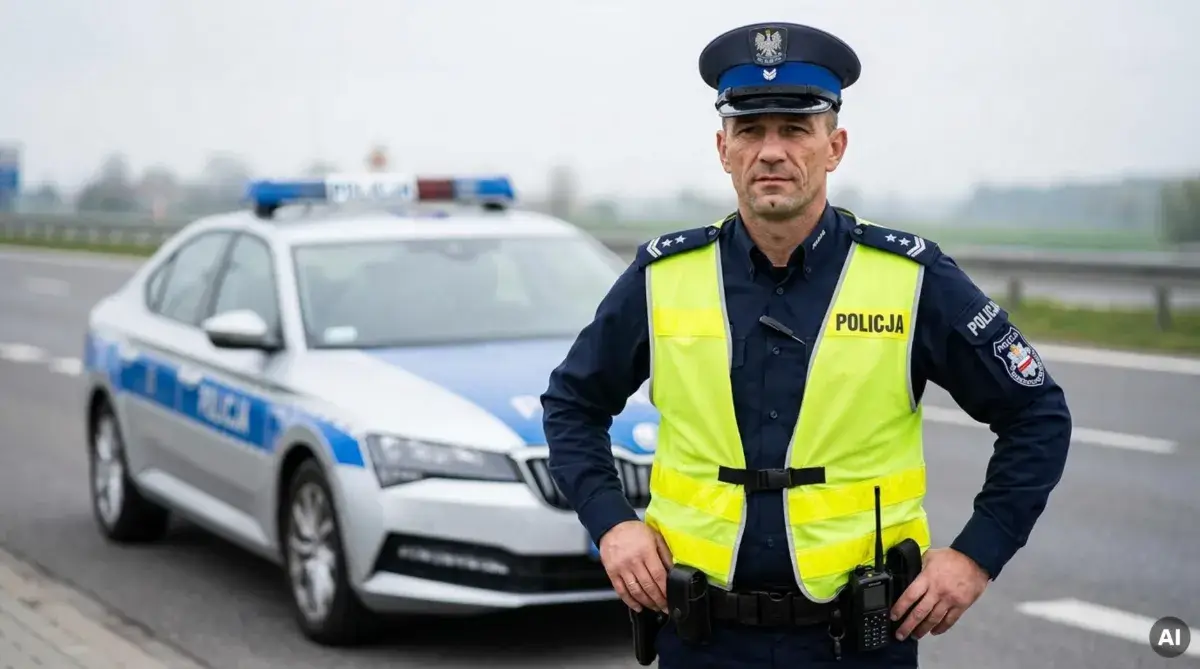
What To Do if an Officer Asks for Unofficial Cash
While roadside corruption in Poland is rare, unofficial payment requests must be met with caution. If someone in uniform hints at a reduced "cash discount" to avoid official paperwork, decline immediately.
Never offer money to speed up a stop or bypass paperwork. Under Article 229 of the Polish Penal Code, attempting to bribe an official is a serious criminal offense carrying penalties of up to eight years in prison. If you suspect inappropriate conduct, calmly note the officer's badge number, decline any informal deal, and insist on standard documentation.
[Check required rental documents]
Can You Challenge or Refuse a Polish Police Fine?
Visiting drivers aren't legally obligated to accept every ticket presented to them. Polish courts, rather than roadside officers, serve as the final authority in disputed traffic matters.
However, before rejecting a fine, consider your supporting evidence alongside the time and practical logistics of handling cross-border court proceedings.
When Refusing a Penalty Notice May Be Appropriate
Challenging a ticket makes sense when you hold verifiable evidence of an error. Examples include dashcam footage proving a traffic light was green, evidence that a speed gun targeted another vehicle on a multi-lane roadway, or clear documentation showing obscured road signage.
If you decide to contest the citation, state your refusal clearly before signing any forms. Once you sign the ticket, you can't retroactively claim you intended to decline it.
Why Accepting a Fine Can Limit Later Appeals
Under Article 101 of the Petty Offenses Procedure Code, signing a mandat or settling a cash fine makes the decision legally final (prawomocny).
Paying or signing confirms your acceptance of liability, which waives your right to a standard judicial trial. Overturning a finalized ticket is restricted to rare legal anomalies, such as when the documented action doesn't constitute an offense under Polish law. You can't reopen a case simply because you reconsidered the situation later.
How Court Proceedings Replace an Accepted Fine
When you refuse a ticket, the officer submits a formal case file to the district court handling that geographic jurisdiction. The court assesses the evidence. If it issues a summary default ruling (wyrok nakazczy) without your presence, you usually have seven days from delivery to lodge an objection (sprzeciw).
Filing an objection sets aside the default order and schedules a regular hearing. While this lets you present a full defense, foreign motorists may need to attend hearings in person, hire Polish legal counsel (an adwokat or radca prawny), and cover certified translation expenses.
How Can You Recognize and Report a Fake Fine Demand?
Fraudsters occasionally target international visitors by impersonating traffic officers or sending fraudulent digital payment requests. Knowing standard police protocols helps protect your personal security and finances.
Legitimate officers follow strict procedural mandates. They won't make personal threats, skip official forms, or demand sums differing from formal paperwork.
Warning Signs of Bribery or Fraud
Suspicious fine demands generally display distinct warning signs. A legitimate police officer will not:
Demand cash without presenting an official, numbered, multi-part state ticket form.
Propose a lower settlement figure in exchange for skipping official paperwork.
Direct you to transfer money to personal accounts, cryptocurrency addresses, wire services, or unverified payment apps.
Operate unmarked private vehicles lacking proper emergency lights while refusing to show official credentials (legitymacja).
Why You Should Never Pay More Than the Documented Amount
Never pay more than the precise PLN sum printed on the official citation. If an officer indicates the penalty is 400 PLN, the ticket must read 400 PLN-never 300 PLN with an extra 100 PLN described as an unrecorded fee.
Every Złoty collected at the roadside must match the serialized receipt slip. Any discrepancy between requested cash and the documented sum indicates unlawful behavior. Confirm all figures before completing the transaction and retain your receipt.
How To Preserve Evidence and Contact the Proper Authority
If you encounter an individual impersonating an officer or attempting extortion, prioritize your safety. Where possible, note the vehicle's registration plate, record badge details, note the time and location, and retain all documentation provided.
If you feel unsafe or face unlawful pressure, dial 112 immediately to connect with Poland's national dispatch service. Describe your exact location and report an unauthorized vehicle stop. To report suspected officer misconduct afterward, contact the Police Internal Affairs Bureau (Biuro Spraw Wewnętrznych Policji - BSWP), which investigates internal police offenses.
Vehicle Equipment, Border Checks, and Cross-Border Driving Realities
Traffic enforcement in Poland extends beyond speed monitoring; vehicle roadworthiness and onboard safety equipment are standard inspection items. Every car driving on Polish roads must carry a working fire extinguisher and a reflective warning triangle. Make sure the fire extinguisher is easily accessible rather than packed away under luggage. A modern, well-maintained rental vehicle should already carry this equipment, but it's worth confirming at pickup.
While first-aid kits and reflective vests aren't strictly mandated for foreign-registered private cars under the Vienna Convention on Road Traffic, Polish authorities expect drivers to carry them. Stepping out of a disabled vehicle on an unlit expressway without a reflective vest can result in an independent fine.
If you're crossing into Poland via external EU borders, remember that Border Guard officers (Straż Graniczna) and National Revenue Administration (KAS) customs agents have direct access to the national fine registry. Unresolved court judgments or outstanding penalty orders from prior visits can surface during passport control. Drivers picking up a vehicle at Warsaw Chopin Airport or another major hub should keep their documents in order for exactly this reason.
While minor camera notices don't trigger border detentions, an unresolved court enforcement order can lead to travel delays or require full payment to border finance officials before you can continue your trip.