12.08.2026
Speed Limits in Poland - A Complete Guide for Tourists
What are the legal speed limits across Poland, and how are they enforced for visiting drivers?
Standard limits range from 20 km/h in residential zones to 140 km/h on motorways, with strict enforcement through automated cameras, unmarked patrol cars, and immediate roadside fines.
Learning these road categories and their default thresholds ensures you travel with confidence and enjoy a smooth journey across the country.
What Are the Speed Limits in Poland?
Poland categorizes its road network into distinct classifications. Each category carries a statutory legal speed limit unless a posted sign indicates otherwise. Because road layout and zone markers determine your speed ceiling, you'll need to recognize the specific category of road you're using.
Unlike countries that repeat speed-limit signs every few kilometers, Poland expects drivers to deduce the correct limit from road architecture, entry markers, and municipal signs. Mistaking an undivided national road for a divided expressway can lead to an unexpected fine, so it's best to master the core limits before setting off.
Passenger Cars and Motorcycles: The Standard Limits in KM/H
For standard passenger cars traveling without trailers and for motorcycles, Poland enforces distinct limits across five main driving environments. Controlled-access motorways (marked by a white highway symbol on a blue sign and designated with the letter “A”) permit a maximum speed of 140 km/h. This gives Poland one of the highest motorway limits in Europe.
Dual-carriageway expressways, marked with the letter “S,” carry a 120 km/h limit when they feature at least two lanes in each direction separated by a physical median.
On other roads, limits decrease as opposing traffic flows interact without barriers. Knowing these statutory baselines keeps traffic flowing smoothly and helps you avoid automated camera citations.
Built-Up Areas: 50 KM/H Day and Night
The standard speed limit in a Polish built-up area (obszar zabudowany) is 50 km/h. While Poland previously allowed drivers to travel at 60 km/h between 23:00 and 05:00, that nocturnal exception has been repealed. The 50 km/h limit applies 24 hours a day unless a specific sign raises or lowers it.
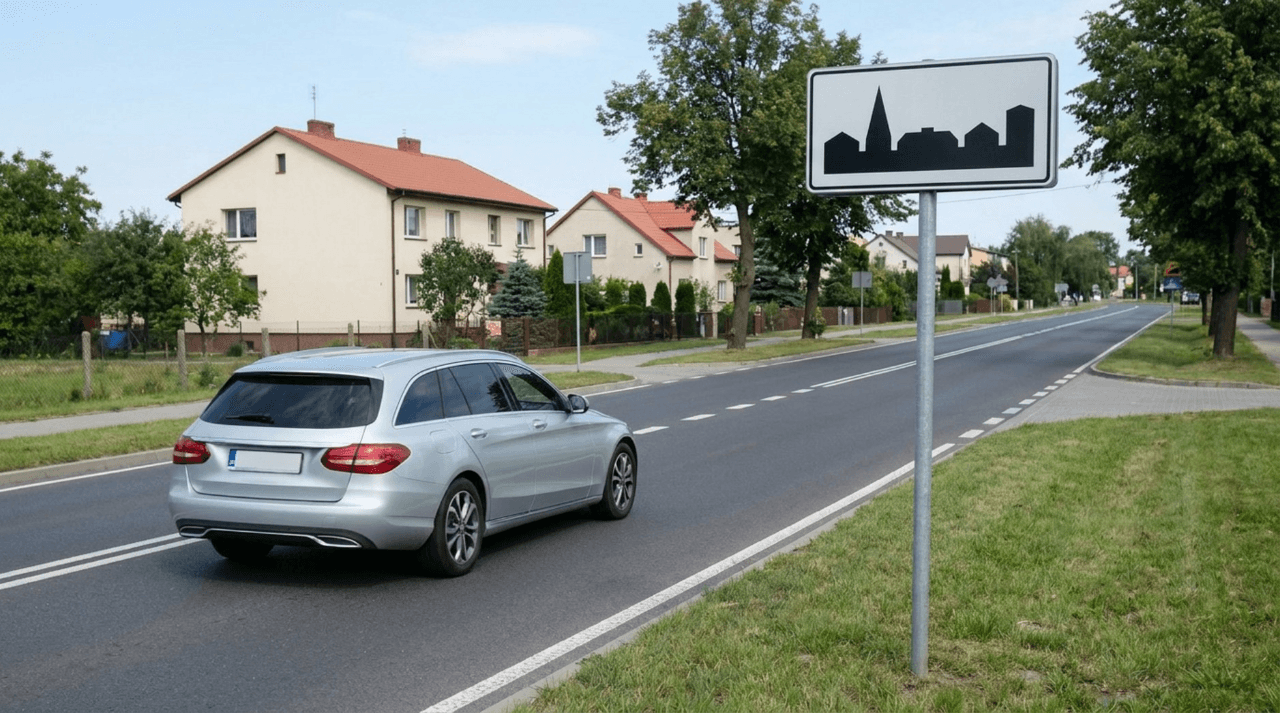
A built-up area begins at Sign D-42: a white rectangular sign displaying a black city skyline. This legal marker doesn't always coincide with municipal borders or green town-name signs. You can legally drive at open-road speeds past a green locality sign, but the moment you cross the black-and-white skyline marker, you must slow down to 50 km/h.
Residential Zones: 20 KM/H
A residential zone (strefa zamieszkania) enforces a maximum speed of 20 km/h. The zone is designated by Sign D-40, a blue rectangular sign showing an adult, a child with a ball, a house, and a car. These areas function as shared public spaces where pedestrians hold complete right-of-way.
Pedestrians may use the entire width of the street, and children under seven may play in the roadway without adult supervision. Vehicle parking is strictly confined to designated bays. When exiting a residential zone onto an adjoining road, you must yield to all cross-traffic, exactly as if facing a give-way sign.
Other Roads Outside Built-Up Areas: 90 KM/H
Outside municipal boundaries, the default limit on standard single-carriageway rural roads is 90 km/h. These routes encompass provincial roads (drogi wojewódzkie) and national roads (drogi krajowe) that connect regional towns and villages.
While 90 km/h is legal, these corridors frequently wind through forests, agricultural land, and historic tree-lined stretches. Narrow unpaved shoulders, slow-moving agricultural equipment, and wildlife make driving below the maximum cap a safer choice, especially at night or during wet conditions.
Single-Carriageway Expressways: 100 KM/H
Poland also operates intermediate high-speed corridors: single-carriageway expressways designated with the letter “S,” along with select dual-carriageway roads outside built-up areas that don't meet full expressway criteria. The standard limit on these routes is 100 km/h.
These roads provide direct regional connections without the infrastructure footprint of a divided motorway. Because opposing traffic is separated only by painted road markings rather than a physical barrier, the lower 100 km/h limit provides vital reaction time.
Check your dashboard speed carefully, as some satellite navigation units mistakenly display a 120 km/h limit on these single-carriageway segments.
How Polish Road Signs Change the Speed Limit
Statutory limits govern standard roads, but posted traffic signs always take precedence. Poland aligns with the Vienna Convention on Road Signs and Signals, though specific local rules dictate where a speed restriction officially starts and ends.
Understanding how speed signs interact with intersections and zone designations ensures you don't travel too slowly after a restriction ends or accelerate prematurely into an enforcement zone.
Recognizing the Speed-Limit and End-Of-Limit Signs
A posted speed limit is displayed on a circular sign with a red border, a white background, and black numerical text (Sign B-33). The limit is canceled either by a circular white sign crossed by diagonal black lines (Sign B-34) or by a general end-of-restrictions sign (Sign B-42), which clears both speed and overtaking bans.
A key regulation that surprises many foreign drivers is that an intersection with a public road cancels a preceding speed-limit sign. The restriction remains active only if the limit sign is repeated immediately after the junction, or if it was posted beneath a designated speed zone sign (strefa ograniczenia prędkości).
For example, if a 70 km/h sign appears on a national road and a public side street joins the corridor, the limit resets to the standard 90 km/h rural ceiling past the intersection.
Temporary Limits Near Roadworks and Hazards
Road maintenance and temporary hazards introduce lower speed limits. In active work zones or over damaged pavement, you'll encounter warning and regulatory signs featuring yellow backgrounds instead of the standard white. These temporary postings override permanent road markings and fixed signs.
On motorways, work zones reduce speeds in stages-stepping down from 140 km/h to 110, 80, and eventually 60 km/h as lanes narrow or merge. Variable message signs on overhead gantries carry full legal authority. When these digital displays post reduced speeds due to collisions, severe weather, or heavy congestion, compliance is mandatory.
Speed Limits for Different Vehicles and Road Situations
The standard limits familiar to visitors apply primarily to light passenger cars. If you're towing a trailer, driving a larger camper, or dealing with adverse weather, lower speed caps apply.
Polish regulations account for vehicle mass, center of gravity, and stopping distances. Exceeding a vehicle-specific limit triggers the same enforcement penalties as violating a posted roadside sign.
Cars Towing Trailers and Caravans
Towing a caravan, horsebox, or cargo trailer changes your car's legal speed profile. Even when a modern vehicle and trailer setup feels completely stable, the legal limits drop significantly on major highways.
A passenger car towing a trailer is restricted to 80 km/h on motorways, expressways, and divided multi-lane roads outside built-up areas. On standard single-carriageway rural roads, the limit drops to 70 km/h. Within built-up areas, the standard 50 km/h ceiling remains in effect.
Poland does not issue high-speed towing permits equivalent to Germany’s “Tempo 100” scheme.
Buses and Heavy Goods Vehicles Over 3.5 Tonnes
Larger motorhomes with a maximum permissible weight above 3.5 tonnes, as well as commercial transport vehicles, follow lower limits. Vehicles over 3.5 tonnes are capped at 80 km/h on motorways and expressways.
Standard coaches operate under an 80 km/h highway limit. However, approved long-distance coaches equipped with technical safety systems (such as advanced braking, speed limiters, and tachographs) may travel at 100 km/h on motorways and expressways.
If you rent a large motorhome or camper, check its gross vehicle weight on the vehicle registration card (Dowód Rejestracyjny) before setting your cruising speed.
Limits That Apply When Visibility, Weather, or Traffic Worsens
Beyond following posted signs, drivers must maintain a safe speed (prędkość bezpieczna) under Article 19 of the Polish Road Traffic Act. Safe speed reflects current visibility, wet or icy asphalt, snow accumulation, and traffic density. A posted limit is not a guarantee that the road is safe at that speed.
Poland regularly experiences thick autumn fog and sudden winter squalls. If fog, snow, or torrential rain reduces visibility below 50 meters, turn on your rear fog lights and slow down to match your visible sight distance. Driving at 140 km/h on a wet motorway during a storm can be classified as dangerous driving if you can't brake safely within your clear distance ahead.
Motorways, Expressways, Tolls, and Fuel Stops
Poland has expanded its primary transit corridors, creating a well-connected network of motorways (Autostrady) and expressways (Drogi Ekspresowe). You can travel effortlessly across the country, from the western border to eastern regions or from Gdańsk down to the mountains, provided you understand how the toll network and service plazas operate.
These corridors combine high travel speeds with varied toll systems and modern rest areas designed for long-distance journeys.
Which Polish Roads Charge Tolls?
Unlike Austria or Switzerland, Poland does not use a universal motorway vignette for passenger cars under 3.5 tonnes. Instead, tolls apply only to specific motorway segments managed by the state or private concessionaires.
The primary toll motorways for light vehicles include:
A1 (AmberOne): The northern section running between Rusocin (near Gdańsk) and Nowa Wieś (near Toruń). It uses physical toll booths alongside automated license-plate billing apps.
A2: The concession corridor between Świecko (at the German border) and Konin, operated by Autostrada Wielkopolska via manual and electronic toll lanes.
A4: The concession segment between Katowice and Kraków, operated by Stalexport with entry and exit toll barriers.
State-managed sections on the A2 (Konin to Stryków) and A4 (Wrocław to Sośnica) no longer feature barrier plazas for passenger cars, relying instead on barrier-free digital payment.
Electronic Toll Payment and Rental Cars
On barrier-free state motorways, drivers pay digitally through the government’s e-TOLL network or certified mobile applications such as Autopay, mPay, or SkyCash. You purchase an electronic motorway ticket (e-bilet autostradowy) linked to the vehicle's registration number before or during your trip according to system rules.
If you're using a car rental, confirm how motorway tolls are handled under your agreement. Many modern fleet providers offer transparent rental terms where toll charges are recorded by plate-recognition cameras and billed to your card. If your rental doesn't include automated toll settlement, simply link the vehicle's license plate to an approved toll app before setting off. Traveling an e-TOLL route without an active digital pass can result in a 500 PLN penalty.
Using Emergency Lanes and Motorway Rest Areas Correctly
The hard shoulder (pas awaryjny) on Polish motorways and expressways is reserved exclusively for vehicle breakdowns, urgent medical issues, and emergency service vehicles. Pulling onto the shoulder to check directions, make a phone call, or rest is illegal and carries significant fines.
For breaks, use designated Motorway Service Areas, known as MOPs (Miejsce Obsługi Podróżnych). These stops are categorized into three service tiers:
MOP I: Basic facilities offering parking bays, picnic tables, and clean restrooms.
MOP II: Adds fuel stations, convenience shops, and fast-food dining.
MOP III: Comprehensive travel centers featuring full-service restaurants and motels for extended breaks.
Requirements for Tourists Driving in Poland
A successful driving tour across Poland requires carrying the correct personal documentation and mandatory onboard safety gear. Traffic police (Policja Ruchu Drogowego) conduct routine vehicle checks, so keeping your paperwork organized ensures stress-free travel throughout your visit.
Preparing the right paperwork in advance keeps roadside checks simple and efficient.
Driving Licence and International Driving Permit Requirements
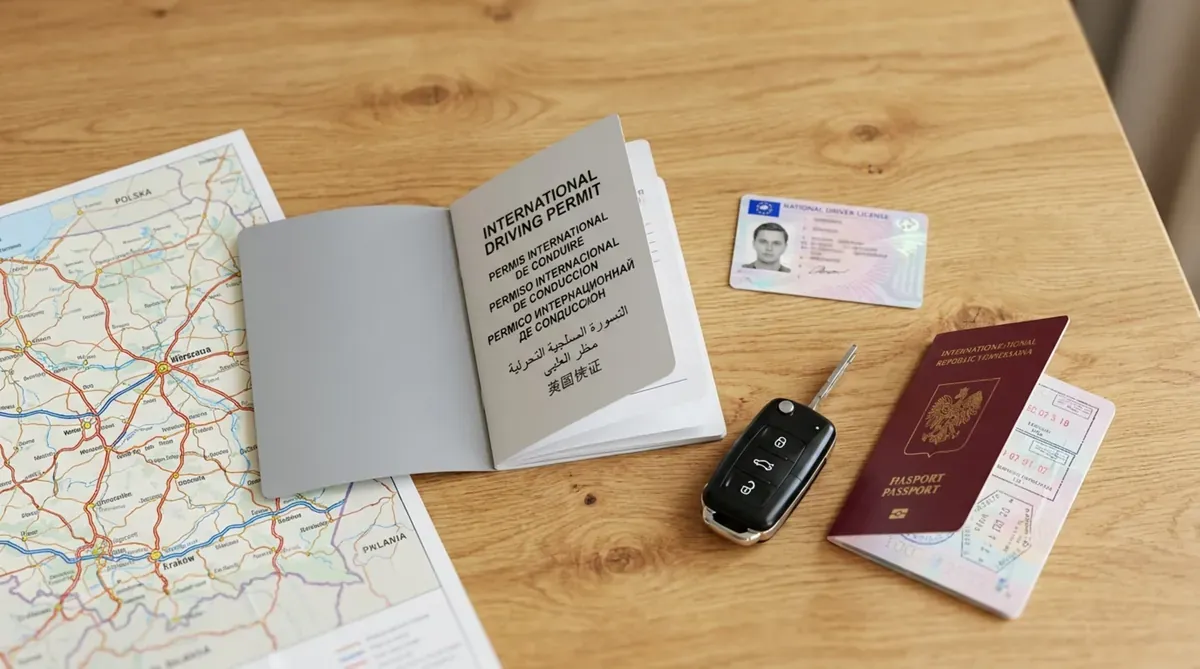
Poland recognizes driving licenses issued by all European Union and European Economic Area (EEA) member states. If your license was issued within the EU or EEA, you can drive all vehicle classes listed on it without an International Driving Permit (IDP) or certified translation.
Visitors holding licenses from non-EU countries-such as the United States, Canada, Australia, or the United Kingdom-should carry an International Driving Permit alongside their domestic license, following the 1949 or 1968 Road Traffic Conventions. The IDP serves as an official translation and is valid only when presented with your original driving license; it cannot be used alone.
Documents To Carry in a Foreign-Registered Car
If you enter Poland in a vehicle registered abroad, keep these original documents in the car:
The original vehicle registration certificate (such as a UK V5C or German Zulassungsbescheinigung Teil I); photocopies aren't accepted.
Valid personal identification, such as a biometric passport or national identity card.
Proof of active third-party motor liability insurance.
A written authorization letter or lease contract from the registered owner if the car isn't registered in your name, which police or border officers may request.
Insurance, Roadside Assistance, and Rental-Car Cover
Third-party liability coverage (OC - Odpowiedzialność Cywilna) is mandatory for every motor vehicle on Polish public roads. Vehicles registered within the EU, EEA, and Switzerland carry reciprocal coverage while driving in Poland.
Drivers visiting from outside these regions must carry an international Green Card (Karta Zielona) or purchase local border insurance (Ubezpieczenie Graniczne) upon entry. It's also prudent to verify that your policy includes collision coverage (AC - Autocasco) and 24/7 support for roadside towing. Recovering a disabled vehicle from an expressway or rural highway can be costly without appropriate coverage.
Speeding Fines and Penalties in Poland
Poland has updated its traffic penalty structure to improve road safety, establishing substantial fines for moving violations. The current tariff (Taryfikator mandatów) is among the stricter frameworks in Central Europe, with heavy financial penalties for speeding.
Excessive speed isn't treated as a minor infraction. Serious offenses can trigger immediate license confiscation and court referrals.
Fines for Exceeding the Limit by Different Amounts
Fines scale upward based on how far you exceed the posted limit, with steep increases beginning once you go more than 30 km/h over. Poland also enforces a repeat-offense rule known as recydywa: if you commit the same serious speeding violation (exceeding the limit by 31 km/h or more) within two years of an earlier offense, the statutory fine doubles.
Amount Above the Posted Speed Limit | Standard Fine (PLN) | Repeat-Offence Fine |
Up to 10 km/h | 50 PLN | 50 PLN |
11 - 15 km/h | 100 PLN | 100 PLN |
16 - 20 km/h | 200 PLN | 200 PLN |
21 - 25 km/h | 300 PLN | 300 PLN |
26 - 30 km/h | 400 PLN | 400 PLN |
31 - 40 km/h | 800 PLN | 1,600 PLN |
41 - 50 km/h | 1,000 PLN | 2,000 PLN |
51 - 60 km/h | 1,500 PLN | 3,000 PLN |
61 - 70 km/h | 2,000 PLN | 4,000 PLN |
71 km/h and above | 2,500 PLN | 5,000 PLN |
Visiting tourists without a permanent residence in Poland must settle fines on the spot (mandat gotówkowy). Traffic patrols carry portable payment terminals, allowing drivers to pay using a debit or credit card. If a foreign driver refuses or cannot pay the roadside fine, police may detain them while transferring the matter directly to a local court.
Penalty Points and Possible Licence Suspension
Poland monitors violations using a penalty-point system (punkty karne). While primarily targeted at Polish drivers-who face license loss at 24 points, or 20 points in their first licensing year-foreign motorists are recorded in the central register. Reaching the threshold revokes your right to drive within Poland.
For visitors, the most critical penalty is an immediate three-month driving suspension. If you're caught driving more than 50 km/h over the posted limit inside a built-up area (obszar zabudowany), officers will suspend your license on the spot. This three-month ban applies nationwide, regardless of where your license was issued.
Speed Cameras, Average-Speed Sections, and Police Checks
Automated speed enforcement is managed by CANARD, an arm of the General Inspectorate of Road Transport. Stationary speed cameras (fotoradary) are housed in bright yellow casings and are preceded by Sign D-51, a blue warning sign depicting a white camera symbol. Fixed cameras must be signposted in advance.
Poland also uses average-speed enforcement corridors (odcinkowy pomiar prędkości). Marked with specific start and end markers, overhead cameras record your entry and exit times over segments spanning 2 to 20 kilometers to calculate your average speed. Furthermore, highway police operate unmarked vehicles equipped with onboard video gear (videorejestratory) that track road speed without triggering radar detection devices.

Driving Safely on Polish Roads
Prioritizing road awareness ensures a comfortable travel experience across Poland. While major expressways feature modern surfaces and clear layouts, regional corridors and urban centers present distinct conditions that require driver attention.
Safe driving involves watching the road layout, anticipating regional driving patterns, and respecting shared pedestrian zones.
Adjusting Speed on Narrow, Uneven, or Potholed Roads
Secondary regional corridors (drogi powiatowe and gminne) differ considerably from primary expressways. Rural routes may lack a painted center line, featuring narrow lanes bordered by deep drainage trenches or unpaved shoulders. Winter freeze-thaw cycles can also leave sudden potholes during spring.
Scenic tree-lined avenues are common throughout Masuria, Pomerania, and Warmia, where mature trees sit close to the asphalt edge. Striking a pothole or gravel verge at 90 km/h can quickly cause a vehicle to veer off path. Lowering your speed well below the legal ceiling on these scenic roads keeps your journey safe and enjoyable.
Safe Speed in Cities, Villages, and Pedestrian Areas
Driving through historic centers such as Kraków, Wrocław, and Poznań calls for steady vigilance. You'll navigate alongside tram lines, cycle tracks, and raised pedestrian crossings. Trams generally hold right-of-way at uncontrolled intersections, and overtaking a stopped tram while passengers board or alight directly from the street is illegal.
Poland provides strong legal protections for pedestrians at zebra crossings. Drivers must yield to pedestrians already crossing and those visibly approaching or waiting to enter the crosswalk. Overtaking another vehicle on or immediately before an unsignalized crosswalk is a severe offense that brings a 1,500 PLN fine alongside heavy penalty points.
Parking Restrictions That Affect Tourist Drivers
Police and municipal guards (Straż Miejska) enforce parking regulations closely. In historic urban areas, Paid Parking Zones (Strefa Płatnego Parkowania) require purchasing a ticket from a curbside meter or paying via a parking app during enforced hours.
Polish law permits parking with two or four wheels on a pedestrian sidewalk only when all of the following conditions are met:
No posted signs prohibit stopping or parking.
The vehicle’s gross weight is 2.5 tonnes or less.
A minimum of 1.5 meters of unobstructed sidewalk remains clear for pedestrians.
The parked vehicle does not impede vehicular movement on the street.
Leaving less than 1.5 meters of pedestrian clearance can result in wheel clamps or your car being towed to a municipal storage yard.
Confirm the Road Type and Posted Limit
As you travel through the country, cross-check road signage, median barriers, and pavement design. Green rectangular signs indicate national roads (drogi krajowe), yellow markers designate provincial routes (drogi wojewódzkie), and blue signs denote motorways and expressways. Aligning these markers with your speedometer ensures you maintain legal speeds.
Before beginning your drive, check that your vehicle meets all national safety requirements. Headlights or daytime running lights must remain on 24 hours a day, all year round. Every vehicle must carry an approved fire extinguisher (gaśnica) and a reflective emergency triangle. Reflective safety vests are mandatory when stepping out of a broken-down car outside built-up areas after dark, though keeping a vest accessible for each passenger is standard practice.
Poland enforces a strict blood-alcohol limit of 0.2 per mille (0.02%); exceeding 0.5 per mille constitutes a criminal offense carrying severe fines, potential imprisonment, and multi-year driving bans.
Finally, if traffic stops abruptly on a motorway due to an incident, drivers must form an emergency “Life Corridor” (korytarz życia): vehicles in the far-left lane pull as far left as possible, while those in right-hand lanes shift right, creating a clear central passage for emergency services.